PVC vs. CPVC Duct: Temperature Limits, Pressure Ratings, and When to Use Each
Summary
PVC and CPVC are both corrosion-resistant thermoplastic duct materials used in industrial exhaust applications. They are not interchangeable, though. PVC handles a wide range of corrosive gases at lower temperatures and is the right call for many standard applications. CPVC extends that range when exhaust temperatures climb, at a higher cost. This blog breaks down where each material works, where each one fails, and what to do when your process eventually needs sturdier material.When a facility needs corrosion-resistant ductwork for acid exhaust, PVC is usually the first material on the shortlist. Low cost, proven chemical resistance, and FM-approved options are available. It checks a lot of boxes.
But corrosive air handling is rarely simple. Exhaust temperatures vary. Chemical concentrations shift. Systems that started in one process area get extended into another. And at some point, someone on the project asks: Should this be PVC or CPVC?
That question doesn't always get the attention it deserves.
Key Takeaways
- PVC is the right choice for standard corrosive exhaust service at lower temperatures. It's cost-effective, FM-approvable, and handles a broad range of acid chemistries.
- CPVC's higher temperature tolerance comes directly from the chlorination of its base polymer. It's not just a premium label on the same material.
- Neither PVC nor CPVC is suitable for aromatic hydrocarbons, esters, or ketones, where chemistry matters as much as temperature in material selection.
- Both thermoplastics have structural limits that show up on large-diameter runs, outdoor installations, and anywhere exhaust temperatures climb above their operating range.
- When your application pushes beyond thermoplastic limits, FRP and SSTeelcoat® are the next step. Not a different brand of PVC.
PVC vs. CPVC: What's the Difference?
PVC is a thermoplastic material ideal for standard, ambient-temperature corrosive exhaust, whereas CPVC is post-chlorinated PVC engineered to handle higher-temperature applications where PVC loses structural stiffness.
Standard PVC
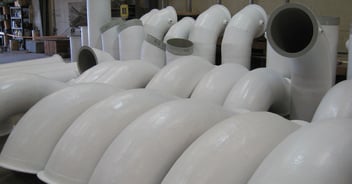
the material in Viron's VI-A-DUC® duct system — is polyvinyl chloride, Type II, Grade I, specified to ASTM D-1784 with a UV inhibitor built into the compound. It's manufactured under SMACNA Thermoplastic Duct Construction Manual standards, FM-approved for fume exhaust service without internal sprinklers, and tested per ASTM E-84 (flame spread rating 14, smoke development rating 754).
For most corrosive exhaust applications running at or near ambient temperatures, it does the job.
CPVC
CPVC is chemically post-chlorinated PVC. That extra chlorination step raises the heat deflection temperature of the base polymer, which is why CPVC can handle higher exhaust stream temperatures that standard PVC cannot. Standard temperature de-rating factors must be applied to both materials at elevated temperatures, and while their chemical resistance profiles are often similar, they're not always the same. CPVC is the right material when your process demands more from the temperature side of the equation.
It costs more, but it’s clearly worth it when the temperature demands it.
When Should You Use PVC vs. CPVC?
PVC is the right material when exhaust temperatures are at or near ambient, the chemical environment falls within PVC's rated compatibility range, and the project budget is a real constraint. Metal finishing, plating operations, many municipal exhaust applications, and process areas without heated acid baths are PVC environments.
It's a legitimate lower-cost option for the applications it fits.
CPVC is the right call when exhaust temperatures are consistently elevated, and your process falls within its chemical resistance range. The cost premium is the trade-off for the temperature headroom. Applications involving heated process tanks, hot scrubber discharge, or high-temperature process exhausts where PVC's limitations become structural liabilities are CPVC territory.
Here’s a more precise breakdown:
Choose PVC when
- Exhaust temperatures remain at or near ambient conditions
- Your chemical environment falls within PVC's compatibility range
- Cost efficiency is an important project consideration
- Applications include plating operations, metal finishing, municipal exhaust, and similar corrosive environments
Choose CPVC when:
- Process exhaust temperatures remain consistently elevated
- Heated tanks or scrubbers produce hotter exhaust streams
- Higher operating temperatures would reduce PVC's structural integrity
Neither material should be selected simply because it's familiar. Temperature and chemistry both determine the correct specification.
Temperature: Where PVC Hits Its Ceiling
PVC starts losing structural stiffness as the temperature rises. Pressure ratings drop. Support spacing requirements tighten. And what was a solid material choice at ambient conditions becomes a liability if process exhaust consistently runs hot.
That ceiling is real. Hot, humid exhaust from process tanks, heated acid baths, or high-temperature scrubber discharge can push PVC past its temperature limits. When that happens, the duct doesn't fail spectacularly. It sags, joints loosen, and leaks develop slowly in places that are hard to inspect.
CPVC handles a higher temperature range before those same problems appear. If your exhaust stream temperature is consistently elevated, CPVC is the honest answer. Not PVC with shorter hanger spacing.
The caveat: neither material solves everything. Both thermoplastics require standard temperature de-rating at elevated service conditions. And both require careful pressure rating verification for the actual operating range of your system, not just rated maximums. Viron's PVC duct carries standard design pressure ratings of 4 inches W.C. positive and 6 inches W.C. negative for exhaust service.
If your project requires something outside those ranges, that's an engineering conversation before fabrication, not after.
Chemical Resistance: More Nuanced Than Most Specs Show
PVC handles a wide range of industrial chemicals well at standard temperatures, including:
- Sulfuric acid (low-to-moderate concentrations)
- Hydrofluoric acid (10%)
- Hydrochloric acid (up to 25%)
- Most common plating chemistries
The Viron PVC Corrosion Table rates many of these environments at "Excellent" or "Good" across Type I and Type II material.
But there are hard limits.
Neither PVC nor CPVC should be used with chlorinated or aromatic hydrocarbons, esters, or ketones. That's a firm boundary. If your exhaust stream contains solvents from cleaning processes, organic vapors, or specialty chemicals in those categories, neither material is the right call, regardless of how the temperature looks.
CPVC and PVC share a similar chemical resistance profile across most industrial acids and alkalies, but they diverge in some specific applications. Certain caustic and concentrated acid combinations that rate as acceptable for CPVC may rate differently for standard PVC at the same temperature. Standard chemical compatibility data recommends selecting the material with a maximum use temperature that matches or exceeds the application requirement.
That also means verifying each component of the system, including gaskets, cements, and fittings, not just the duct itself — a key part of any corrosive environment material selection strategy.
That last point trips up more projects than the base material selection does.
Structural Performance on Large Runs
Temperature and chemical compatibility get most of the attention in thermoplastic duct selection. Structural performance on large-diameter runs gets less. But it shouldn't.
PVC is a lower-stiffness material than fiberglass reinforced plastic (FRP) or coated stainless steel. Support spacing requirements are tighter, especially at elevated temperatures and on larger diameters. Longer spans between hangers on large PVC duct introduce deflection risk. Thermal expansion on long runs has to be managed with expansion joints. Outdoor installation adds UV exposure to the equation — Viron's PVC material specification includes UV inhibitor in the compound, and UV coatings are available, but thermoplastic duct outdoors does require more attention over its service life than alternatives.
Viron custom-fabricates PVC duct from 4 inches to 96 inches in diameter. That range covers most industrial corrosive exhaust applications. The upper end of that range in PVC requires engineering review for support spacing, pressure ratings, and the specific exhaust conditions of your project.
When Thermoplastics Aren't the Answer
Both PVC and CPVC hit walls. When your process exhaust runs consistently hot, when fire rating requirements call for Class 1 duct compliance, when large-diameter runs require longer support spans, or when your facility needs outdoor installations without UV maintenance burdens, thermoplastics stop being the right starting point.
FRP handles higher temperatures than PVC (up to approximately 250°F with the right resin selection) and offers better structural performance on FRP duct for large diameter runs. Viron manufactures FRP duct from 4 inches to 120 inches in diameter.
Viron's SSTeelcoat® system — 304 or 316 stainless steel substrate with Halar® (ECTFE) internal coating, FM-labeled Class 1 per FM 4922, smoke under 50 — handles 300°F+ continuous service, outdoor installation without UV degradation, and the fire rating requirements that thermoplastics and FRP don't reliably meet. It's a different category of product entirely, not a premium version of the same one.
The material conversation is part of a larger system conversation. Ductwork connects to fans, scrubbers, dampers, and stacks. When those components come from a single manufacturer who has engineered them together, performance is predictable. When they come from multiple vendors, accountability for system performance gets complicated fast.
Viron manufactures complete corrosive air systems — PVC, FRP, and SSTeelcoat ductwork, wet scrubbers, industrial fans, and dampers — all under one roof. If you're sorting through material selection for a new installation, an expansion, or a failing system replacement, our engineering team can help you work through the chemistry, temperature, and structural requirements before you're locked into a specification.
Contact us today or request a quote for your next project.
Frequently Asked Questions
Can PVC and CPVC duct be used in the same exhaust system?
Yes, in principle. The two materials can coexist in different sections of a system if the thermal and chemical conditions genuinely differ between zones. That said, joining the two requires attention to compatible cements, gaskets, and fittings. Material transitions introduce potential failure points, and every component in the transition needs to be verified for compatibility, not just the duct sections themselves.
Does UV exposure affect CPVC the same way it affects PVC?
Both are thermoplastics and susceptible to UV degradation if left unprotected outdoors over time. UV-stabilized compounds and UV coatings are available for both materials, but outdoor installations of either material should be planned with UV exposure in mind — not treated as an afterthought once the duct is already on the roof.