What Is a Class 1 Duct and Why Should You Care?
Summary
Class 1 is a fire performance designation governed by ASTM E-84, measuring flame spread and smoke development across duct materials. It's referenced in NFPA 820 and FM 4922 — the standards most commonly applied to industrial and municipal corrosive exhaust systems. Both fiberglass reinforced plastic ductwork and coated stainless steel duct can meet the Class 1 threshold, but through different means: FRP requires vinyl ester resin to qualify, while SSTeelcoat Halar coated stainless steel carries an FM-labeled Class 1 rating inherent to the material itself.
Fire ratings, resin requirements, and what "Class 1" means for corrosive air handling specifications.
Corrosive exhaust systems get evaluated on chemistry, temperature limits, and installed cost. Fire classification tends to come up later — sometimes at permit submission, sometimes during an insurance review. It's not usually on the agenda until it has to be.
Class 1 is a fire performance designation for duct materials. Most specifications reference it. And fewer of them define it completely enough to hold up.
5 Key Takeaways
- Class 1 describes fire performance, not material quality. FRP and coated stainless steel can both achieve it, through very different means, with very different documentation requirements.
- The spec detail most likely to cause a submittal problem isn't flame spread, but smoke development. FRP with vinyl ester resin can achieve Class 1 flame spread while still producing higher smoke than a coated metal system. Whether that creates a compliance gap depends on the code pathway and the AHJ. Addressing smoke development explicitly in the specification closes that gap before submittal rather than during it.
- PVC isn't a Class 1 pathway. If the project requires Class 1, PVC isn't a candidate. Regardless of cost.
- FM labeling is documentation, not just a claim. SSTeelcoat Halar coated stainless steel carries an FM-labeled Class 1 rating under FM 4922 with a smoke developed index below 50 — a third-party verified number. A general Class 1 claim on a cut sheet is a different thing, and AHJs can tell the difference.
- Specifying "Class 1 fiberglass reinforced plastic ductwork" without naming the required resin is an incomplete specification. Vinyl ester resin is what gets FRP to Class 1 flame performance — standard polyester typically doesn't. If the spec doesn't call it out, a bid can be satisfied with a product that won't perform as intended.
The Test Behind the Classification
Class 1 (also written Class I in some standard references) comes from ASTM E-84, the standard test method for surface burning characteristics of building materials. The test measures two things: how far a flame travels along the surface of the material (flame spread) and how much smoke the material generates in the process (smoke development). Lower scores are better on both counts.
The classification shows up in NFPA 820, the fire protection standard widely applied to wastewater treatment and collection facilities, and in FM 4922, the Factory Mutual standard governing low flame, low smoke materials in industrial applications. Facilities operating under NFPA 820 may be able to eliminate internal fire suppression systems that would otherwise be required inside duct systems when Class 1 materials are specified. And some may qualify for reduced insurance requirements.
Install non-compliant material and discover it during a code review, and you're not looking at a simple material swap. You're looking at a change order conversation nobody budgeted for.
The AHJ conversation is also shorter when the documentation is clean. FM-labeled Class 1 materials don't need exception requests. Materials requiring equivalency arguments often take longer, and the outcome isn't guaranteed.
What Class 1 Looks Like Across Materials
Fiberglass Reinforced Plastic Ductwork
Fiberglass reinforced plastic ductwork is heavily specified for corrosive air handling applications, and it can achieve Class 1 flame performance — but only with specific resin formulations.
Vinyl ester resins are the path to Class 1 flame rating in an FRP air duct system. Standard polyester resins typically don't reach that threshold. This is a detail that gets lost in bids: fiberglass reinforced plastic ductwork isn't a single product, though. The resin system determines fire performance, and not every FRP submittal specifies vinyl ester by default. If a specification calls for Class 1 and doesn't define the required resin type, the fire rating is an assumption, not a verified fact.
There's a second variable that doesn't always get addressed alongside the flame rating: smoke. FRP air duct can achieve Class 1 flame spread performance with vinyl ester resin, but smoke development in fiberglass composites is generally higher than in coated metal systems. Whether that creates a compliance gap depends on which code pathway applies and what the AHJ is reviewing.
SSTeelcoat Halar Coated Stainless Steel
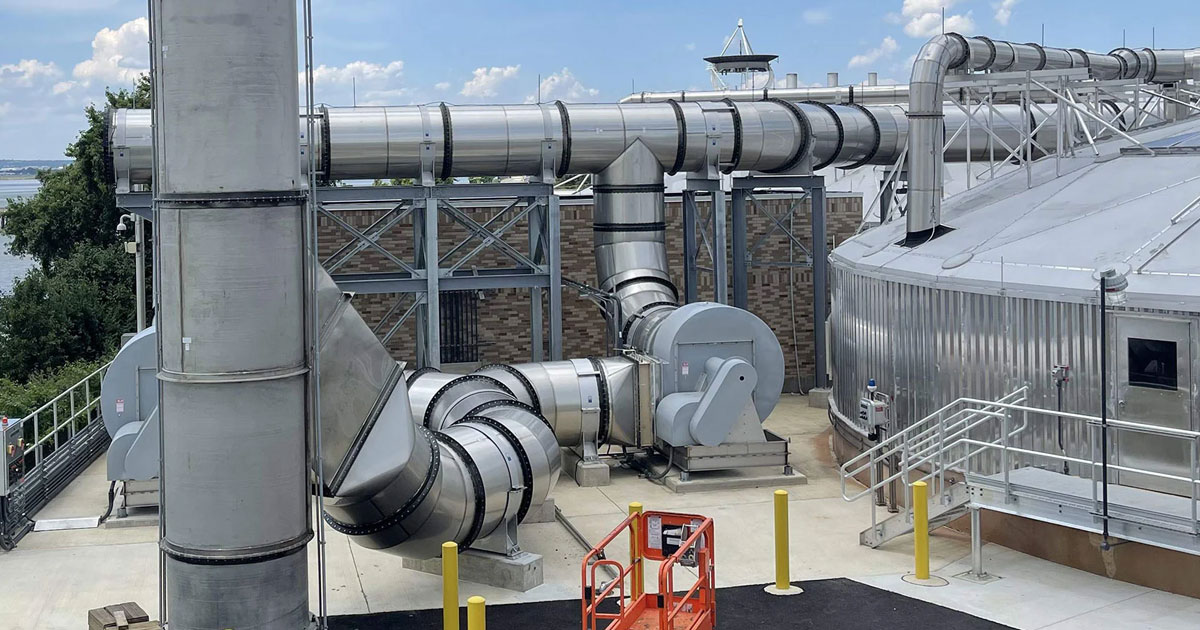
Viron's SSTeelcoat stainless steel duct system carries an FM-labeled Class 1 rating under FM 4922 with a smoke developed index below 50. The system uses a 304 or 316 stainless steel substrate with a Halar® (ECTFE) interior coating applied by electrostatic powder coating. It complies with NFPA 820. The fire performance is a property of the base materials — not contingent on resin selection, field lamination, or fabrication consistency from one shop to the next.
That distinction — Class 1 by material versus Class 1 by resin and fabrication specification — is worth understanding before the spec is written.
SSTeelcoat handles 300°F continuous temperatures. FRP air duct is rated to approximately 250°F. For most corrosive exhaust applications, that gap isn't the deciding factor. In configurations with elevated process temperatures or concentrated heat, it narrows the options.
PVC Ductwork
PVC isn't a Class 1 pathway. It carries a significantly higher smoke development rating than either FRP or coated stainless steel. It's the right material for certain lower-requirement applications, but it shouldn't be on the candidates list for any project with a Class 1 specification.
Writing a Specification That Holds Up
Specifying "Class 1 ductwork" without further definition is a common starting point. It's also an incomplete one. A specification that holds up through submittal and inspection will address:
- The test standard (ASTM E-84) and whether FM labeling is required
- For FRP systems: the required resin type and whether both flame spread and smoke development thresholds must be met
- Submittal documentation confirming actual test results — not a general Class 1 claim on a cut sheet
A spec that reads "Class 1 fiberglass reinforced plastic ductwork" without resin requirements can be bid and satisfied with a product that doesn't perform the way the engineer intended. Finding that out during submittal review is the better outcome. Finding it after installation isn't.
What Else Goes into the Material Decision
Class 1 is a floor, not a performance grade.
Two materials can both carry the designation and behave very differently in a fire event, a code review, or a conversation with an insurer. Knowing where they diverge is what makes the specification do its job.
When the fire rating requirement isn't negotiable — NFPA 820 facilities, applications requiring FM 4922 documentation, projects with high AHJ scrutiny — SSTeelcoat Halar coated stainless steel is the straightforward specification. The fire performance is inherent to the material, not contingent on what resin was ordered or how it was fabricated in the field.
FRP with vinyl ester resin is a legitimate alternative where budget is the binding constraint and smoke development requirements are less restrictive. The upfront cost differential is real, and FRP has a documented track record in large-diameter, lower-temperature corrosive exhaust applications. If those conditions describe your project, it's worth the conversation.
Viron manufactures both — SSTeelcoat and FRP air duct — along with PVC ductwork for applications that don't require Class 1 compliance. If you're working through a material selection for a corrosive exhaust system and want to run the application against fire rating requirements, contact Viron today or request a quote.
Frequently Asked Questions
Does specifying Class 1 ductwork eliminate the need for fire suppression systems inside duct runs?
It can. For facilities governed by NFPA 820, specifying Class 1 materials often eliminates the requirement for internal sprinkler systems inside duct runs — and may reduce insurance costs. Whether it applies in a specific situation depends on the facility classification, the applicable edition of NFPA 820, and the AHJ's interpretation. It's worth confirming with your AHJ early in the design process rather than assuming the exemption applies.
Do fittings, transitions, and other components need to carry the same Class 1 rating as the straight duct?
A complete system — including fittings, elbows, tees, and transitions — should be specified to the same fire performance standard as the straight duct sections. Specifying Class 1 for straight runs and leaving fittings unaddressed creates a gap in both performance and documentation.
Does installing Class 1 FRP ductwork require specialized contractors?
Yes. And this is a detail that gets underestimated at the bid stage. Fiberglass reinforced plastic ductwork requires specialized fabrication and bonding techniques. Field connections need to be made per SMACNA guidelines, including interior bonding that requires cure time before the system can be pressurized. Skipping or rushing that interior bonding is a documented failure mode. SSTeelcoat installs differently — it uses a bolt-together flanged Van Stone connection system that doesn't require welding, toxic resins, or field lamination, so standard mechanical contractors can handle the installation.
Can Class 1 ductwork be field-modified after installation?
It depends on the material. Coated stainless steel duct can be cut and re-flanged on site. FRP requires a more involved process — proper cutting procedures, edge reinforcement, and leak-tight connection methods that need cure time before they can be put back in service. If the system design is likely to change, or if future expansion is possible, that difference is worth factoring into the material selection before the spec is finalized.
How do you verify a vendor's Class 1 claim during the bid process?
Don't accept a general Class 1 reference on a cut sheet as verification. For FM-labeled products, request the FM label and documentation referencing the applicable standard (FM 4922 for industrial duct). For products tested to ASTM E-84, request the test report — not a summary claim — confirming both the flame spread index and the smoke developed index from a certified testing laboratory. For FRP systems specifically, request written confirmation that the submitted product uses vinyl ester resin, not polyester, along with the resin manufacturer and grade. If a vendor can't produce that documentation at the bid stage, that's the answer.