The ductwork decision happens before a facility is built. But the consequences play out for decades.
Facility managers and plant engineers working in corrosive environments—semiconductor fabs, wastewater treatment plants, chemical processing facilities, metal finishing operations—know this better than anyone. Pick the wrong material upfront, and you’re looking at premature failures, unplanned shutdowns, and replacement costs that dwarf the original installation. Pick right, and the system runs quietly in the background for 20 years.
So which material actually delivers better ROI in aggressive chemical environments? Let’s go through each contender honestly.
Key Takeaways
- Carbon steel is the traditional default—and in corrosive service, it’s also the fastest to fail. The real cost isn't the purchase price, but it’s emergency replacement plus downtime.
- Stainless steel is the common upgrade engineers reach for, but it has limits in chloride environments and some high-acid service that often surprise facilities counting on it.
- FRP with vinyl ester resin, properly specified and fabricated, delivers 20+ years of service life in corrosive environments where both metals and thermoplastics fall short.
- Single-source system design—one manufacturer building ductwork, scrubbers, and fans together—eliminates the multi-vendor coordination failures where most corrosive air projects quietly lose money.
Carbon Steel: The Traditional Default And Its Hidden Costs
Carbon steel is the default. It’s what gets specified when nobody has thought hard about the exhaust chemistry yet. In general ventilation—dry air, no chemical exposure—it does the job at low cost.
Corrosive environments are another matter entirely. Hydrogen sulfide gas from wastewater treatment. Acid fumes from etching and plating operations. Solvent vapors from semiconductor fabrication. These exhaust streams attack carbon steel from the inside out. Rust forms. Walls thin. What looked structurally fine during a visual inspection last quarter may now have pinholes. By the time a leak shows up externally, the damage is already extensive.
The ROI calculation for carbon steel in corrosive service includes replacement cost, emergency labor, production downtime, and potential regulatory exposure when your exhaust system fails containment. None of those numbers is small.
Stainless Steel: The Common Upgrade, With Real Limits
When engineers recognize that carbon steel won’t hold up, stainless steel is usually the first alternative they reach for. And in many applications, it’s a legitimate choice. But the assumption that stainless resists everything is expensive when it’s wrong.
316 stainless is genuinely corrosion-resistant against many chemicals. But it has some limits. Chloride-bearing environments cause pitting. Certain acid concentrations attack it at elevated temperatures. And even when the substrate holds up, uncoated stainless steel in exhaust service can experience corrosion at welds, joints, and areas where protective oxide layers were compromised during fabrication.
Maintenance costs on stainless systems in truly aggressive chemical service tend to be higher than engineers expect. Inspection intervals shrink. Repairs require skilled welders. It’s a better starting point than carbon steel—but it’s not the finish line.
All that being said, coated stainless steel, in most cases, boasts a less expensive total life cycle compared to any other ductwork material because it tends to last longer. And it can tolerate higher temperatures.
PVC: The Lower-Cost Alternative That Has a Ceiling
Thermoplastic ductwork is a legitimate lower-cost alternative for specific applications—certain acid chemistries, lower temperatures, and straightforward runs with moderate chemical concentrations. For those situations, PVC’s cost advantage is real and worth capturing.
The problems surface when applications push beyond those limits. Thermoplastics have temperature ceilings that FRP exceeds. Their lower stiffness requires closer support spacing—particularly on large-diameter runs—which adds installation cost and structural complexity. Outdoors, UV degradation is a genuine issue. Unprotected thermoplastic exposed to sunlight will deteriorate over time, requiring UV-stabilized materials, shielding, or dark pigments to compensate.
When your process pushes exhaust temperatures up, or when a large-diameter duct needs to span significant distances without intermediate supports, PVC starts struggling.
Where FRP Ductwork Wins on ROI
Fiberglass reinforced plastic duct systems occupy the middle ground between thermoplastics and coated stainless steel—and in the right applications, that middle ground is exactly where you want to be.
The chemistry works. FRP ductwork built with vinyl ester resins handles a broad range of acids, alkalis, and organic solvents found in semiconductor, wastewater, chemical processing, pharmaceutical, and metal finishing operations. The resin-rich inner corrosion barrier—typically on the order of 100 mils thick—provides chemical resistance, backed by structural plies that build wall thickness and maintain dimensional integrity. Outdoors, UV-resistant gel coat protects against weathering.
Properly engineered FRP systems last. Our field experience with FRP installations consistently shows 20+ years of service life in corrosive environments when resin selection matches the chemistry and laminate quality is controlled. That’s not a marketing claim; it’s what we see when customers call us for a system expansion on a duct run we installed two decades ago.
Maintenance costs tell the ROI story clearly. FRP doesn’t rust. It doesn’t require painting, coating touch-ups, or the kind of periodic corrosion inspection that metal systems in chemical service demand. Systems that last longer and fail less save repair dollars and protect operational continuity. A ductwork failure in an operating semiconductor fab or an active wastewater treatment facility quickly exceeds being a scheduled maintenance event and becomes an emergency.
FRP also handles the structural demands that push thermoplastics to their limits.
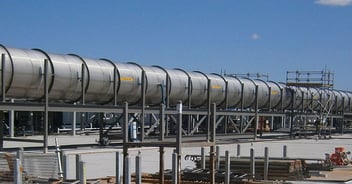
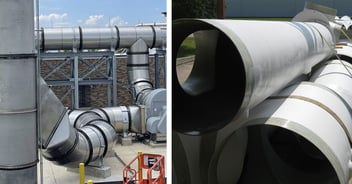
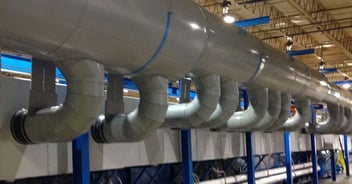
We custom-fabricate FRP ductwork from 4-inch diameter up to 120 inches and larger, with engineering capability for complex geometries, multi-story facility routing, and outdoor stacks that face UV exposure, temperature swings, and weather without deterioration. And when FRP ductwork integrates with FRP scrubbers and other system components, material compatibility eliminates thermal expansion mismatches at flanged connections—a failure point that mixed-material systems create unnecessarily.
Which Ductwork Material Is Right for Your Corrosive Environment?

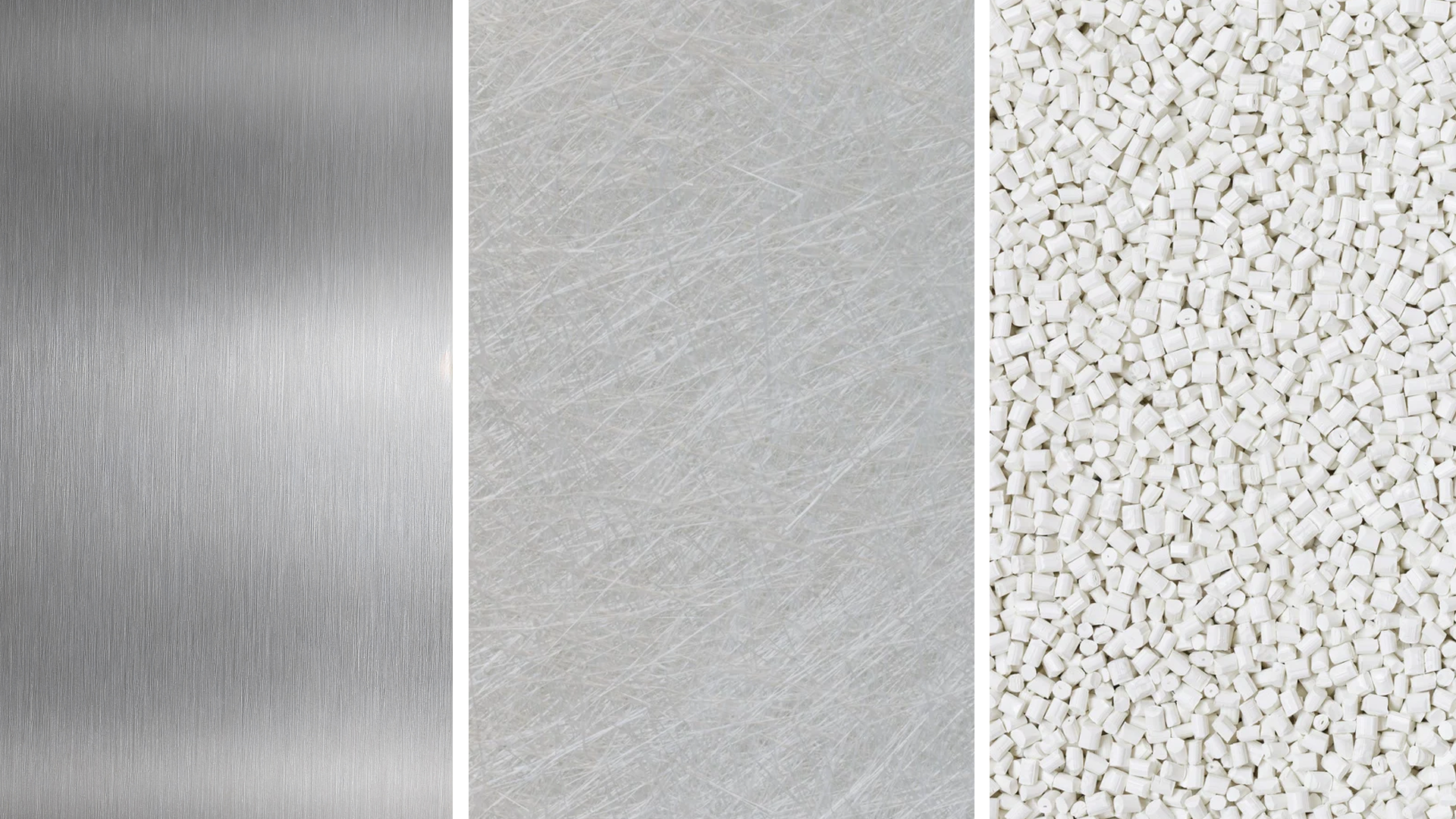
Carbon Steel
The Traditional Default Low upfront cost. High long-term risk. Corrosive exhaust attacks from the inside out—often months before a leak shows externally. Replacement plus emergency downtime erases any initial savings fast.

Stainless Steel
The Common Upgrade Better than carbon steel, but not bulletproof. Chloride environments cause pitting. High-acid concentrations attack welds and joints. Maintenance costs in aggressive service routinely exceed expectations. Most cost-effective over the total life cycle.
PVC
The Lower-Cost Alternative Works well for moderate chemistries at lower temperatures. Struggles with large-diameter runs, elevated heat, and outdoor UV exposure. Know the ceiling before you spec it.

FRP
The Corrosion Workhorse Vinyl ester resin handles acids, alkalis, and solvents that defeat metals and thermoplastics alike. Properly built: 20+ years of service life with minimal maintenance.
One manufacturer. Every component. Zero finger-pointing.
Viron designs and builds complete corrosive air systems—ductwork, scrubbers, fans, and stacks—all under one roof.
The System Integration Factor
Here’s what rarely gets discussed in material comparison articles: the ROI calculation on ductwork doesn’t exist in isolation.
Ductwork connects to wet scrubbers, fans, dampers, and stacks. When those components are designed and manufactured together, as an integrated system from a single source, performance is predictable. Airflow matches design. Pressure drops align with engineering calculations. Component dimensions fit.
When ductwork comes from one vendor, scrubbers from another, and fans from a third, you inherit a coordination problem. Submittals don’t align. Dimensions conflict. And when the system underperforms, every vendor points to someone else’s component. That accountability gap is where projects quietly bleed money.
We’ve seen this play out more times than we can count. It’s one of the main reasons we’ve built our business the way we have, manufacturing every component in-house so the pressure drop calculations, the material compatibility, and the dimensional fit are all our problem to solve before the equipment ships.
Is FRP Always the Answer?
The short answer is no, FRP is not always the best solution.
Applications with Class I fire rating requirements, high-temperature service above FRP’s operating range, or frequent field modification needs are sometimes better served by coated stainless steel. Viron’s SSTeelcoat® system—stainless substrate with Halar® (ECTFE) internal coating—handles approximately 300°F continuous service and carries FM-labeled Class I fire ratings where FRP falls short.
The point isn’t to sell FRP. The point is to match the right material to the appropriate application—and then engineer the complete system around it. That’s a conversation worth having before you specify.
Why Viron for FRP Ductwork?
We’ve been manufacturing corrosion-resistant air cleaning systems for over 50 years. Our engineering team carries an average of 25+ years of tenure. Which means when you describe your exhaust chemistry, you’re talking to someone who has almost certainly solved a version of that problem before.
Our 65,000 square-foot Texas facility produces FRP ductwork from 4 to 120 inches in diameter using computer-controlled filament winding equipment, conforming to SMACNA and National Bureau of Standards PS 15-69.
We also manufacture the scrubbers, fans, dampers, and stacks that connect to that ductwork—all under one roof, all engineered as a system.
Clients like Micron, Boeing, Global Wafers America, and DC Water have trusted us to design and build complete corrosive air systems across some of the most demanding applications in industrial manufacturing and municipal infrastructure. When the system has to work—and failure genuinely isn’t an option—that’s the kind of track record that matters.
FRP is not the right fit for every project. But if you’re specifying ductwork for a corrosive environment and need the system designed by people who build every component of it, that’s exactly what we do.
Contact Viron to discuss material selection, system design, and lifecycle cost analysis for your corrosive air challenge. Our engineering team has solved air handling problems across semiconductor fabs, wastewater treatment plants, pharmaceutical facilities, and chemical processing operations—and we manufacture every component of the solution.