Is Your Ductwork Failing? 7 Warning Signs Facility Managers Can't Ignore
Summary
Seven warning signs indicate ductwork failure rather than routine maintenance: recurring joint leaks, visible corrosion on metal duct, sagging PVC, UV-degraded outdoor runs, leaks at material transitions, unexplained scrubber efficiency drops, and a prior replacement showing the same failure modes. In corrosive air applications, most signs point to a material incompatibility. The correction is a material change, not another patch cycle.A diagnostic guide for facility managers running corrosive exhaust systems, and what each warning sign is telling you about your duct material.
Ductwork rarely announces when it's failing. It leaks at a joint; you patch it. The exhaust smells off, so you check the scrubber. A hanger looks wrong, so you add a support. Then one morning, the shift supervisor is on the phone and you're managing a system failure on a timeline that isn't yours.
Every one of those incidents is a data point. Most of them point to the same conclusion: the material running in that duct was never right for the chemistry flowing through it.
Here's how to read them.
Key Takeaways
- The same joint leaking twice suggests a material incompatibility.
- Rust or pitting on a metal duct in chemical service means the substrate has already lost.
- Sagging PVC is the material telling you it wasn't built for this load.
- Outdoor duct that's chalking or checking is past the point of inspection. UV degradation doesn't plateau.
- Leaks at material transitions are a system design problem, not a torque problem.
- When scrubber efficiency drops and the unit checks out, pressure-test the duct before you do anything else.
- If your replacement system is showing the same failures as the original, the material choice is the problem—not the installation.
1. You're Patching the Same Joint More Than Once
A single leaking flange is a maintenance event. The same joint leaking again within a year is a material problem.
In corrosive air service — whether you're exhausting hydrogen sulfide from a wastewater treatment facility, hydrofluoric acid from a semiconductor fab, or mixed acid vapors from chemical or pharmaceutical research — recurring joint failure almost always means incompatibility between the duct material and the exhaust chemistry. The joint isn't wearing out; the material is being attacked.
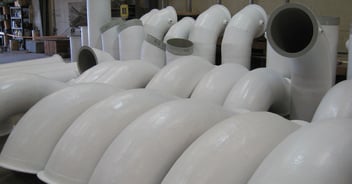
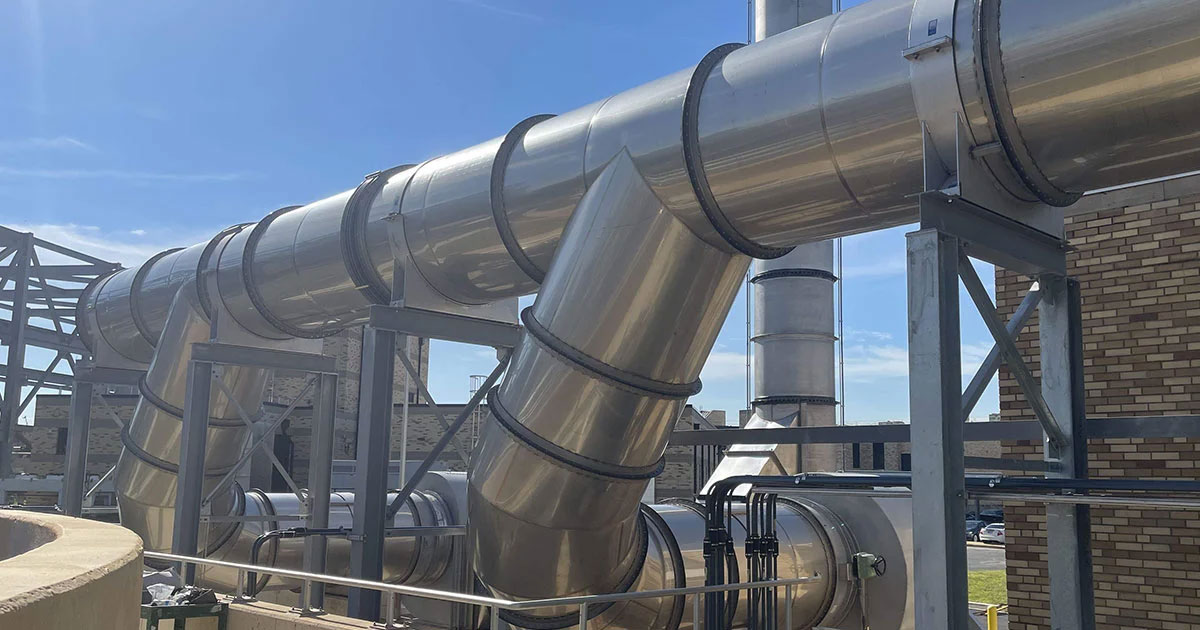
Fiberglass reinforced plastic ductwork built with vinyl ester resins handles a broad range of acids, alkalis, and organic solvents. SSTeelcoat stainless steel with Halar® (ECTFE) applied via electrostatic powder coating keeps corrosives off the metal substrate entirely. Both are engineered for this type of tough chemistry. Carbon steel, uncoated stainless, and plain PVC are not.
Patching the same joint twice is the sign. You need to address the material, not the symptom.
2. Visible Corrosion on Metal Duct in Chemical Service
Uncoated carbon steel corrodes in corrosive exhaust service. That much is expected. What surprises facilities is how often uncoated 316 stainless fails under the same assumption that it won't.
316 stainless has real limits. Chloride-bearing environments cause pitting. Certain acid concentrations attack the substrate at elevated temperatures. Even where the base metal holds up, corrosion at welds and joints — where the protective oxide layer was disrupted during fabrication — is a documented failure pattern in chemical exhaust applications.
If you're seeing rust, pitting, or surface degradation on metal ductwork in corrosive service, you've already passed the point of deferred maintenance. Continued patching is borrowing against a replacement cost that's accumulating regardless.
3. Your PVC Is Sagging Between Hangers
PVC has a legitimate place in corrosive air handling — certain acid chemistries, moderate concentrations, straightforward routing, lower temperatures. For those applications, its cost advantage is real.
The problems, however, show up when the application pushes past those limits. Thermoplastics have structural ceilings. Lower stiffness means closer hanger spacing is required, particularly on large-diameter runs. When process temperatures creep up or the duct diameter increases, PVC deflects between supports in ways that create stress concentrations at joints and connections.
Visible sagging isn't a hanger spacing problem, but rather the material telling you it wasn't specified for this load. Fiberglass reinforced plastic ductwork is engineered to handle the structural demands that thermoplastics can't — with wall thickness built to diameter, operating pressure, and application requirements. A 48-inch FRP air duct carries different structural demands than a 48-inch PVC run, and it's designed to meet them.
4. Outdoor Duct That's Chalking, Cracking, or Fading
Walk your outdoor runs. If PVC installed three or four years ago is already chalking, checking, or showing surface brittleness, that's UV degradation. And it doesn't plateau. The surface oxidizes, the material loses impact resistance, and structural integrity keeps declining. Sometimes faster than the interior corrosion that prompted the installation.
It's not a maintenance condition. There's nothing to inspect your way out of.
FRP air duct with UV-resistant gel coat is engineered for outdoor exposure from the start — not UV-shielded, not painted, not worked around. The gel coat is part of the laminate design, not a field fix. Many of the FRP stacks and outdoor duct runs we've installed are still in service after two decades. That's what the material was built to do.
5. Leaks at Transitions Between Different Materials
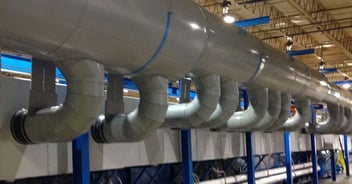
Mixed-material systems — FRP duct connecting to a steel scrubber, PVC transitions to stainless flanges — create thermal expansion mismatches that show up as leaks at connections. Facilities often troubleshoot these as installation problems. They're not.
Different materials expand and contract at different rates. Over thermal cycling, the mismatch works on flanged joints. Gaskets compress unevenly. Flanges develop leak paths. The larger the diameter and the greater the temperature swing, the more pronounced the problem becomes, and the more often you're out there re-torquing connections that shouldn't need it.
This is a system design problem, not a torque specification problem. It shows up specifically when a facility specs ductwork from one vendor, scrubbers from another, and fans from a third — and nobody owns the thermal interface between them. When ductwork, scrubbers, and connecting components come from the same material platform — fiberglass reinforced plastic throughout, or SSTeelcoat throughout — thermal expansion characteristics match. The failure mode goes away because the condition that causes it was never introduced.
It's one of the less obvious arguments for single-source system manufacturing. The finger-pointing between vendors when a flanged connection fails is, in our experience, more expensive than the leak itself.
6. Scrubber Efficiency Has Dropped, But the Unit Checks Out
This one gets misdiagnosed more than any other sign on this list. Scrubber performance falls off, the unit gets inspected and serviced, and the actual cause stays invisible. Because it's upstream.
Scrubber removal efficiency depends on what enters it. If ductwork upstream is leaking, dilution air pulls contaminant concentration down before the exhaust stream ever reaches the scrubber. The scrubber can be performing exactly as designed and still produce bad efficiency numbers, because the inlet concentration isn't what it should be. You're measuring a symptom of a duct problem and attributing it to the scrubber.
The diagnostic sequence matters here: pressure-test the duct system before you draw conclusions about scrubber performance. If the duct can't hold pressure — due to joint failure, coating deterioration, or corrosion-driven wall thinning — the scrubber data doesn't mean what you think it means.
We'll occasionally get a call from a facility that has already replaced the scrubber packing, verified the recirculation pump, and checked the mist eliminator — and the efficiency numbers still haven't moved. Nine times out of ten, we find the problem in the duct. Start there.
7. You've Already Replaced This Ductwork Once
If your facility has been through a full ductwork replacement in the past decade and the replacement system is showing the same failure modes, the problem isn't the installation quality, but rather the material choice.
Chemistry doesn't change for a system (typically). If hydrofluoric acid, hydrogen sulfide, or a mixed solvent exhaust stream destroyed the original system, the same chemistry will destroy the replacement if the same material is specified again.
The correction isn't another patch cycle or another replacement in kind. You need a material change. FRP or SSTeelcoat, properly specified for the actual exhaust chemistry, doesn't repeat this failure pattern. Field experience with properly engineered FRP installations consistently shows 20+ years of service life in corrosive environments when resin selection matches the chemistry and fabrication quality is controlled. That's not a replacement cycle. That's a system that doesn't become an emergency.
The Common Thread
Every sign on this list points to the same root cause: ductwork running in an application it wasn't built to handle. The chemistry wins eventually. The question is whether the failure happens on your schedule or the exhaust stream's.
Not everybody gets excited about ductwork. We understand that. But Viron is the only U.S. manufacturer that produces complete corrosive air handling systems in SSTeelcoat coated stainless steel, fiberglass reinforced plastic, and PVC under one roof. That means we can evaluate your application across all three material platforms and recommend the right one — not the one we happen to make.
If your system is showing any of these signs, the most useful starting point isn't a quote. It's a conversation about what's flowing through the duct. Describe your exhaust chemistry, your current material, and what you're seeing. Our engineering team has worked through versions of this problem in semiconductor fabs, wastewater treatment facilities, chemical processing plants, and aerospace operations.
We'll tell you what we think is happening and what to do about it.
Viron International Corporation has designed and manufactured custom industrial air cleaning systems for more than 50 years. Our engineering team averages 25+ years of experience across semiconductor, municipal, industrial, chemical, aerospace, and pharmaceutical applications. Contact Viron today or request a quote.
Frequently Asked Questions
How do I know whether my application needs FRP or SSTeelcoat?
Start with the chemistry and the fire code. SSTeelcoat handles higher continuous temperatures (around 300°F), carries an FM-labeled Class I fire rating, and is the default recommendation for facilities governed by NFPA 820. FRP makes more sense when the project involves large-diameter custom fabrication, material compatibility with FRP scrubbers is a design factor, or the budget makes coated stainless difficult to justify. If you're not sure which side of that line you're on, describe the exhaust chemistry and the fire code requirements. That conversation usually narrows it quickly.
Does my facility's fire code affect duct material selection?
Yes, and it's often the deciding factor before chemistry even enters the conversation. NFPA 820 governs many wastewater treatment facilities and requires Class I-rated ductwork in certain areas. SSTeelcoat carries an FM-labeled Class I fire rating per ASTM E-84 and complies with FM 4922. FRP with vinyl ester resins can achieve conditional Class I — but it's not automatic. Confirm your fire code pathway before finalizing material selection.
Can a failing system be partially replaced, or does the whole run need to come out?
It depends on the material and the failure pattern. SSTeelcoat can be cut and re-flanged in the field, which makes partial replacement practical. FRP modifications require cutting procedures, edge reinforcement, and cure time — which argues for getting the design right before installation rather than counting on easy field changes later. If failures are concentrated at specific joints or sections, a targeted replacement may solve it. If the failure pattern is distributed across the run, that's a material problem and a full replacement is usually the right answer.
How do I inspect ductwork for internal degradation before it shows externally?
On FRP, look for resin discoloration and surface crazing at joints and any accessible interior surfaces — those are early indicators of liner erosion. On SSTeelcoat, coating blistering or delamination at seams is the signal. Pressure testing will surface leaks that aren't yet visible from the outside. On older FRP systems in aggressive chemical service, wall thickness measurement at suspect sections identifies thinning before it becomes a structural failure. If your system is showing any of the signs covered in this article, schedule an inspection before the next planned shutdown — not after.