What Every Plant Engineer Should Know About Air Pollution Scrubber Efficiency
Summary
Wet scrubber removal efficiency depends on system design—packing media selection, scrubber configuration, ductwork material compatibility, and integrated engineering accountability—not on any single component in isolation.
Most conversations about scrubber efficiency start in the wrong place. Engineers pull spec sheets, compare removal rates, debate packing media. And then they connect the scrubber to ductwork sourced from a different vendor, with no guarantee that it was designed for the same airstream. Then they wonder why the system underperforms at commissioning.
Every component in a corrosive exhaust system affects how the others perform. The scrubber depends on what the duct delivers to it. The duct depends on the fan maintaining design velocity. The fan depends on the total system resistance that nobody has calculated end-to-end. Pull one variable out of alignment, and the performance gap shows up somewhere unexpected.
Here's what that means in practice.
Key Takeaways
- Packing media problems are routinely misdiagnosed. A water authority may spend nearly a year adjusting chemistry on an underperforming ammonia scrubber before anyone opens the vessel to find the problem was channeling in the packed bed.
- What the duct delivers to the scrubber determines what the scrubber can do. Leaking joints and internal corrosion change the airstream the scrubber was designed to handle, and the scrubber takes the blame for a problem that started upstream.
- Fiberglass-reinforced plastic ductwork handles a wide range of chemicals—but has limits worth knowing before you specify. Where Class I fire ratings or sustained high temperatures apply, coated stainless steel is the right material.
- Scrubber configuration is an engineering decision with performance consequences, not solely a footprint decision. Choosing between vertical, horizontal, and blower-scrubber designs based on available floor space alone is one of the more predictable ways to create a startup problem.
- Single-source system design means the pressure-drop calculations work because no assumptions are being handed off to another vendor. That accountability is the difference between a system that hits its removal targets at commissioning and one that spends its first year being debugged.
What Typically Drives Wet Scrubber Removal Efficiency?
A wet scrubber works by exposing contaminated air to a scrubbing liquid—usually water or a chemical solution—through sprays, packed media, or mist. The liquid reacts with or absorbs the pollutants. Cleaned air exits. It’s simple in concept, but demanding in execution.
Removal efficiency is governed by several variables that interact with each other. Inlet gas flow (measured in ACFM) sets the baseline for everything else. Feed a scrubber outside its design envelope and efficiency drops fast. Contaminant loading rate matters, too. The concentration of acids, ammonia, or other gases entering the system determines how aggressively the scrubbing chemistry has to work.
Temperature is one thing engineers sometimes underestimate. Run hot exhaust through equipment rated for cooler service, and you're not only reducing efficiency, but also degrading the scrubber itself.
Then there's the packing media. This is where wet scrubber efficiency usually lives or dies.
Why Packing Media Is the Heart of Scrubber Performance
Inside a packed bed wet scrubber, the packing media exists for one reason: to maximize surface area for gas-liquid contact while keeping resistance to airflow as low as possible. A more active wetted surface means more contact time, which means higher removal rates.
The failure mode is channeling. When packing nests or distributes unevenly, sections go dry. Contaminants pass through those dry zones without ever contacting the scrubbing solution. Efficiency craters. And because it happens gradually, it gets misread. The plant engineer adjusts chemistry, the operations manager suspects the pH controller, and nobody looks at the packing until someone opens the vessel six months later.
We've seen this at municipal wastewater facilities and chemical processing plants alike.
A regional water authority spends the better part of a year troubleshooting an ammonia scrubber that’s consistently missing its removal target, so they adjust chemical feed rates, recheck pH setpoints, and swap nozzles. Six months of chemistry adjustments, and nobody has opened the vessel. When they finally do, the packed bed tells the whole story: media selection wasn't matched to the vessel geometry and liquid loading rate, leaving dry zones across nearly a third of the cross-section.
The fix costs a fraction of what the facility has already spent chasing the wrong variables.
Packing selection isn't a catalog exercise. It's an engineering decision that accounts for temperature, vessel size, pressure drop, scrubbing media chemistry, and target removal efficiency. Polypropylene random packing—styles like Jaeger Tri-Packs® and Lantec Lanpac®—works well for acid and ammonia scrubber applications because of its high void fraction and resistance to fouling. But what's right for a semiconductor acid scrubber may not be the right call for a chrome scrubber in a metal finishing plant.
Liquid distribution matters just as much. Spray nozzles and weir troughs have to cover the entire packing section consistently. An uneven distribution system creates the same dry-zone problem as poor packing selection. Just for a different reason.
How Scrubber Configuration Affects Efficiency and Footprint
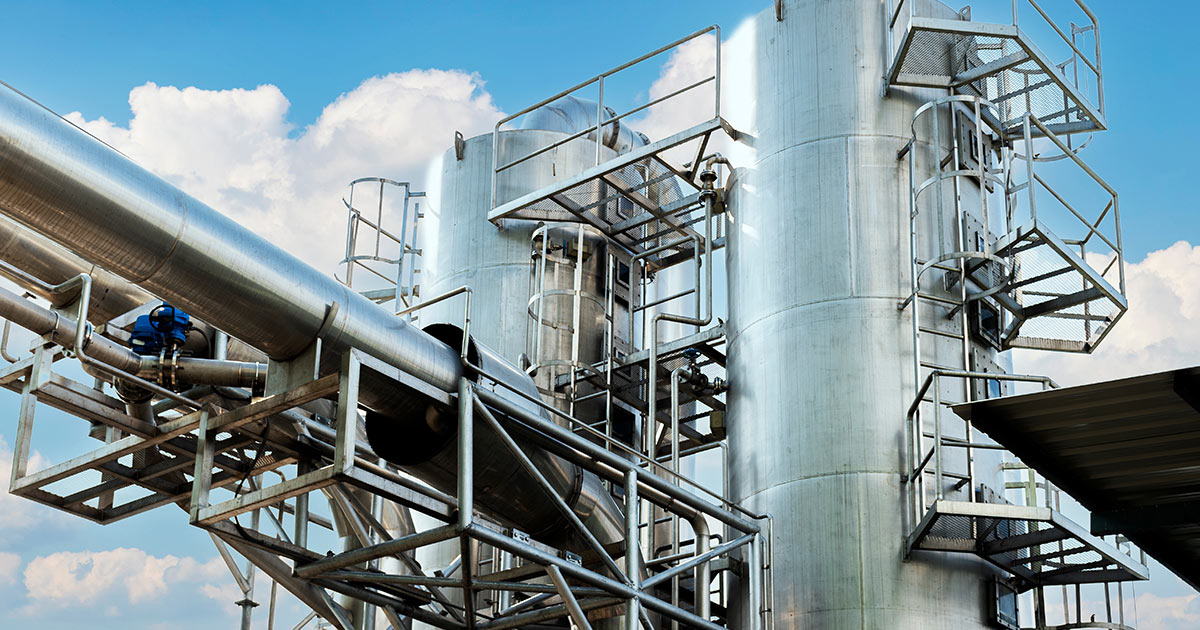
There's no universal scrubber design. Vertical packed tower scrubbers, horizontal cross-flow designs, and integrated blower-scrubber packages each make sense in different situations. Your wet scrubber selection affects more than the footprint.
- Vertical scrubbers offer high removal efficiency in a compact footprint. They're well-suited for acid gases and ammonia removal in facilities where floor space is tight and removal requirements are demanding.
- Horizontal scrubbers trade some removal efficiency for lower pressure drop and easier maintenance access, a legitimate trade-off in facilities where access frequency justifies the design choice.
- The blower-scrubber integrates the fan and scrubber into a single package: fewer field connections, less coordination overhead, lower installed cost for small to mid-size corrosive exhaust applications.
Why Ductwork Material Directly Impacts Scrubber System Performance
Here's the piece of the efficiency conversation that gets skipped most often: what happens before the air reaches the scrubber?
If the ductwork is failing—corroding from the inside, leaking at joints, degrading under UV or temperature exposure—the contaminated airstream you spec'd the scrubber to handle isn't the airstream the scrubber actually sees. Diluted air through leaking joints throws off concentration calculations. Corrosion debris can foul the packed bed. And when removal efficiency misses the target, the scrubber takes the blame for a problem that started upstream.
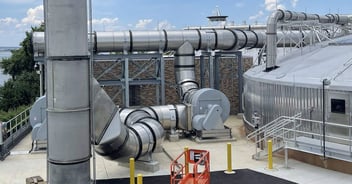
Fiberglass reinforced plastic duct is the most common material choice for corrosive exhaust systems, and for good reason. FRP air duct with vinyl ester resin construction handles a broad range of acids, alkalis, and organic solvents, making it a practical fit for semiconductor fabs, wastewater treatment plants, chemical processing, and metal finishing operations.
The corrosion barrier construction—a resin-rich surfacing veil layer backed by structural mat plies, approximately 100 mil combined—is what separates a system that runs 20 years from one that starts failing in year three.
We've installed fiberglass reinforced plastic ductwork alongside FRP scrubbers at facilities ranging from a silicon wafer manufacturer's $4.5M system to a computer hardware campus where the complete FRP package (scrubbers, fans, and ductwork) ran under $800K.
The material earns its place in the right applications.
Where fiberglass reinforced plastic ductwork hits its limits—Class I fire rating requirements, sustained temperatures above its operating range, or facilities where the specialized bonding that FRP field joints require isn't something the installing contractor can reliably execute—coated stainless steel ductwork is the more durable path.
Viron's SSTeelcoat® system uses 304 or 316 stainless substrate with a Halar® (ECTFE) interior coating. It carries FM 4922 labeling for Class I low flame/low smoke service, handles 300°F continuous, and goes together with a bolt-together flanged system that doesn't require resin work in the field. Set it and forget it.
The material choice isn't always obvious. That's precisely why it matters who's making it.
Scrubber Efficiency: What's Really Controlling Your Removal Rate
Your scrubber can only perform as well as the system feeding it.
Inlet conditions set the ceiling.
Wrong ACFM, temperature, or contaminant load at design. No field adjustment recovers it.
Pressure drop tells the truth.
Rising differential across the packed bed means channeling. Most engineers check chemistry first and find out later.
The duct run is part of the equation.
A degrading FRP air duct changes the airstream before it reaches the scrubber. The scrubber takes the blame.
One team. One calculation. One accountable manufacturer. Scrubbers, ductwork, and fans designed separately create gaps. Designed together, they don't.
What System Integration Has to Do With Efficiency
Scrubbers, ductwork, fans, dampers, and stacks are not independent components. Design them together, and the pressure drops, airflow velocities, and dimensional interfaces align. Source them separately, and you own the gap between what each vendor promised and what the assembled system eventually delivers.
Viron has built its business around that distinction. When our engineers design a complete industrial air cleaning system—wet scrubbers, corrosion-resistant ductwork, fans, controls—system performance is our accountability. There's no pointing at the duct vendor when removal efficiency misses the target at startup. No dispute over whose pressure drop calculation was wrong. One phone number.
One of the largest systems we've delivered—a multi-scrubber semiconductor fab installation valued at over $3M—ran that way. Eight FRP scrubbers, engineered and manufactured as a complete package. The airflow math worked because the same engineering team handled the entire calculation.
For facility managers, that matters at budget review time. For plant engineers, it matters the first week after startup.
The Question Worth Asking Before You Specify
Scrubber efficiency is deterministic. If you get the inlet conditions right, match the scrubber design to the contaminant load, specify the right ductwork material for the chemical environment, and engineer it as a system, it performs. Miss any one of those variables, and you're chasing the problem for years.
The facilities that end up calling us to troubleshoot underperforming systems usually have one thing in common: the components were designed in isolation. Different vendors, different engineering assumptions, nobody accountable for how it all fits together. It's a fixable problem. But it's a much more expensive fix than getting the design right the first time.
If your facility is in the design phase, mid-project, or running a system that isn't hitting its removal targets, that's the conversation to have. Request a quote from Viron's engineering team.
FAQs About Air Pollution Scrubbers
How do I know if my wet scrubber's efficiency problem is a packing issue versus a chemistry issue?
Check the pressure drop across the packed bed first. Channeling and fouling show up there before they show up anywhere else. And we've seen facilities spend months adjusting chemical feed rates on a scrubber that had a media problem the whole time. If pressure drop looks normal and removal efficiency is still off, then pH setpoints, liquid-to-gas ratio, and nozzle distribution are the right places to look.
Can fiberglass reinforced plastic ductwork and coated stainless steel ductwork be used in the same system?
Yes. Mixed-material systems are a practical reality at large facilities—fiberglass air duct where chemical exposure and budget favor it, SSTeelcoat where fire ratings or temperature demand it. The engineering work is in the transition points. FRP and coated stainless steel have different thermal expansion characteristics, and connections between dissimilar materials need to be designed to accommodate that movement. Otherwise, joint stress and leakage follow.
What information does an engineer need before a wet scrubber system can be properly specified?
Inlet gas flow in ACFM, contaminant identity and loading rate, airstream temperature, required removal efficiency, and indoor versus outdoor installation. That's the minimum. Most engineers come to us with the scrubber spec already written and the ductwork and fan treated as an afterthought. That's usually where the trouble starts. The system gets built around a scrubber that was never sized with total system resistance in mind.