Top 5 Mistakes in FRP Duct Installation and How to Avoid Them
Summary
FRP duct systems deliver 20-plus years of service life in corrosive industrial environments, when resin selection, joint execution, support design, and system engineering are done right. Most premature failures trace back to decisions made at the spec and installation stage, not the material itself.FRP duct fails for a reason. Well, usually the same five reasons.
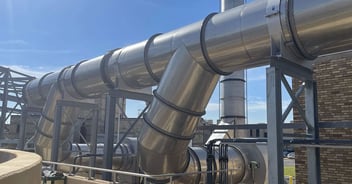
Fiberglass reinforced plastic ductwork earns its place in corrosive industrial environments—semiconductor fabs, wastewater treatment plants, chemical processing operations, and metal finishing facilities. Properly specified and installed, these systems run for 20-plus years without painting, without corrosion inspection cycles, without the emergency replacements that blow maintenance budgets and shut down production.
But "properly specified and installed" does a lot of work in that sentence.
We've seen FRP air ducts fail well before its expected service life, and the failure traces back to one of five mistakes made before the system ever went into service.
Key Takeaways
- Resin selection determines whether the system lasts 20 years or degrades on Day One. A generic "corrosion-resistant FRP" spec that ignores actual exhaust chemistry isn't a spec, but guesswork.
- Joints often fail before duct walls do. Perpendicular flange faces, correct bolt spacing, compatible gaskets, proper surface prep—skip any of it, and you've built the leak in before startup.
- Under-engineered support doesn't announce itself at installation. It shows up later as deflection, joint stress, and flanges that won't seal.
- FRP can't be field-modified like coated stainless steel. If the layout is still evolving, that's a material selection conversation. Before the purchase order, not after.
- Multi-vendor sourcing creates a coordination problem that surfaces as a performance problem. Nobody's engineering accounts for the complete system because nobody designed it as one.
Mistake #1: Choosing the Wrong Resin for Your Exhaust Chemistry
The resin is the chemical barrier. Get it wrong and the duct is degrading from the moment you start pushing exhaust through it. You just haven't seen it yet.
Vinyl ester resins handle a broad range of industrial exhaust: hydrofluoric acid, sulfuric acid, phosphoric acid, alkalis, and organic solvents. Standard polyester resins cost less and degrade faster in aggressive chemical service—sometimes far faster than a project timeline assumes. The resin-rich inner veil layer, roughly 100 mils thick, is only an effective corrosion barrier if the resin chemistry is matched to what's actually running through the duct.
The fix isn't complicated, though.
Get a detailed exhaust analysis before you specify. Document every chemical species, concentration, and operating temperature range. Then work with a manufacturer who matches resin selection to your specific chemistry, not a generic "corrosion-resistant FRP" spec that treats every exhaust stream the same.
Mistake #2: Cutting Corners on Flange and Joint Execution
Joints are where fiberglass reinforced plastic ductwork fails. Rarely in the middle of a straight run, but at the connections.
Flanged joints require faces perpendicular to the duct centerline, with sufficient bolt spacing and gaskets that seat evenly across the full face. A camber exceeding 1/8 inch prevents even compression—no seal, just a slow leak that becomes a fast one when temperatures cycle. Gasket material must be chemically compatible with the exhaust stream, at least 1/8 inch thick, with appropriate Shore A hardness for the environment. Metal washers belong under every bolt head and nut.
Bell-and-spigot joints require proper insertion depth and an overwrap that equals or exceeds the structural capacity of the parent duct wall. Surface preparation—sanding approximately 6 inches back from the joint—isn't a suggestion. It's the only way to achieve adhesion that holds under service conditions. Joints that skip this step look fine at installation. They just don't stay that way for very long.
Mistake #3: Under-Supporting Large-Diameter Runs
A 48-inch FRP duct can span a meaningful distance without deflection, but hanger spacing has limits, and those limits tighten as diameter and operating pressure increase.
Band-type hangers contacting 180° of the duct surface are required. That contact area matters. Point loads from undersized or narrow strapping concentrate stress at exactly the points you can't see failing until it's too late. Spacing beyond manufacturer recommendations for the given diameter and wall thickness creates deflection that stresses every flanged joint in the run—and FRP air duct systems have a lot of joints.
For large-diameter ducts, 48 inches and above, under-engineered support structures are a recurring problem in the field. The duct itself is frequently fine. The support system frequently fails it.
Mistake #4: Making Field Modifications Without Proper Procedures
This one catches contractors off guard, particularly those who've worked primarily with coated stainless steel. SSTeelcoat and similar bolt-together systems can be cut and re-flanged on site without specialized procedures or cure times. FRP air duct cannot.
Field cutting fiberglass reinforced plastic ductwork requires edge reinforcement and proper laminate overwrap at any new connection, and that overwrap requires cure time before the joint can be stressed. Skip the reinforcement, rush the cure, or skip the surface preparation, and you've introduced a stress concentration at exactly the point that sees the most mechanical loading in the system.
If field modifications are likely—during installation or after commissioning as the process evolves—factor that into material selection before the purchase order goes out. FRP is an excellent choice for a defined, finalized layout. Projects with layouts still in flux deserve a different conversation.
Mistake #5: Multi-Vendor Sourcing Without System-Level Engineering
Buy your fiberglass reinforced plastic ductwork from one manufacturer, your scrubber from a second, and your fan from a third, and you've created a coordination problem that surfaces as a performance problem.
The symptoms are predictable. Airflow doesn't match the design. Pressure drops exceed predictions. Thermal expansion coefficients between connected components may differ enough to drive flange leaks when temperatures cycle. Nobody's engineering accounts for the complete system because nobody designed the complete system.
What follows is familiar to anyone who's been through it: the scrubber manufacturer points at fan capacity, the fan supplier questions the duct resistance calculations, and the duct fabricator challenges the scrubber's pressure drop specs. The facility sits offline while consultants sort through competing technical claims.
Single-source manufacturing eliminates this.
When ductwork, wet scrubbers, fans, and stacks come from one manufacturer, fan curves are calculated against actual system resistance, including every fitting, the real scrubber pressure drop, and the stack effect. Duct walls are designed for the pressure and vacuum conditions that the integrated system creates. Material compatibility at flanged FRP-to-FRP connections is engineered in, not negotiated after problems appear.
That means one call when something goes wrong, one set of documentation, and one source for replacement parts.
5 Mistakes That Kill FRP Duct Systems Before Their Time
1. Wrong Resin
Vinyl ester matched to your exhaust chemistry. Anything less and the corrosion barrier is already failing.
2. Poor Joint Execution
Perpendicular flange faces, compatible gaskets, and surface prep 6 inches back. Skip any of it, and the leak is built in at installation.
3. Under-Engineered Support
Band-type hangers at 180° contact, spaced to spec. Deflection doesn't announce itself, but shows up as joint failures months later.
4. Unplanned Field Modifications
FRP requires edge reinforcement, laminate overwrap, and cure time. It can't be cut and re-flanged on site like coated stainless steel.
5. Multi-Vendor Sourcing
Nobody's engineering accounts for the full system because nobody designed it as a whole.
Viron manufactures FRP ductwork, wet scrubbers, fans, and stacks as a complete system, engineered under one roof.
When FRP Is Right, and When It Isn't
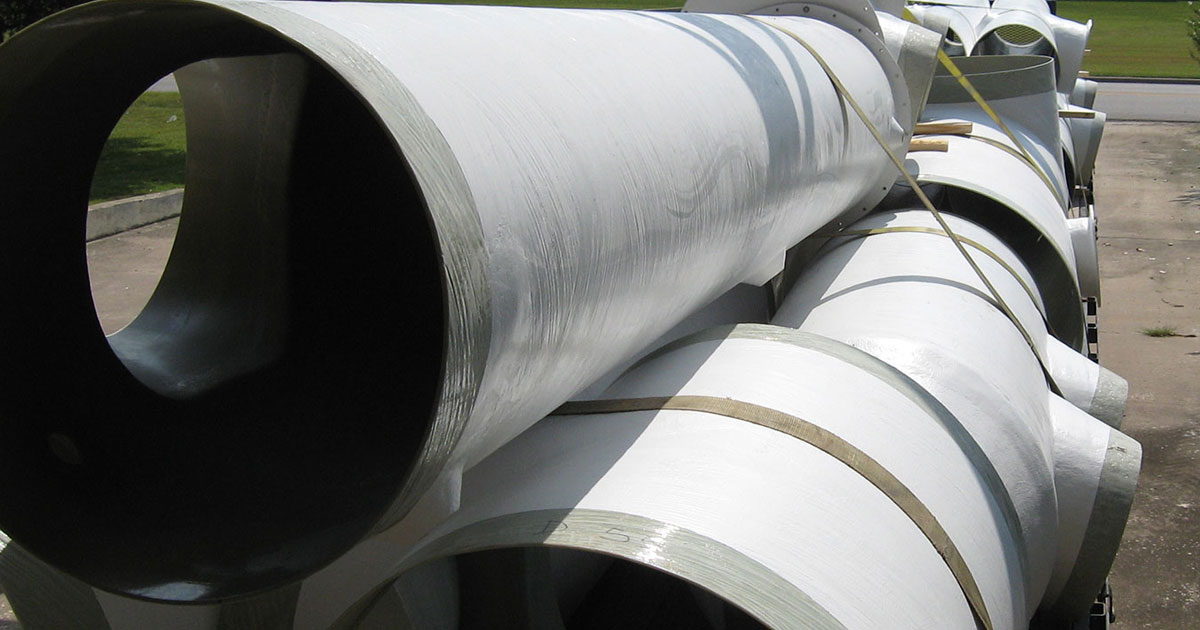
FRP air duct handles demanding chemical environments that defeat carbon steel and push thermoplastics past their limits. Custom-fabricated from 4 to 120 inches in diameter, it's the right specification for complex routing, large-diameter outdoor runs, and applications where the ductwork, wet scrubbers, and other system components share the same material chemistry.
Some applications favor SSTeelcoat coated stainless steel instead, specifically where Class I fire ratings are required, service temperatures exceed FRP's ceiling, or field modification after commissioning is likely. Getting that call right before the spec is written is considerably less expensive than getting it wrong after installation. Plus, coated stainless steel has a lower total cost over its lifetime due to it lasting longer than FRP.
Viron has manufactured complete corrosive air handling systems—FRP ductwork, wet scrubbers, fans, dampers, and stacks—from our Texas facility for more than 50 years.
Clients have trusted our FRP air duct systems in semiconductor fab exhaust, H₂S-laden wastewater applications, and acid fume service across chemical processing facilities.
If you're specifying fiberglass reinforced plastic ductwork for a corrosive application, contact our engineering team to review your exhaust chemistry and discuss material selection—or request a quote to get the conversation started. We'll tell you directly whether FRP is the right fit, or whether something else makes more sense.
FAQs About FRP Duct Installation
Can FRP ductwork be repaired in the field, or does it need to be replaced?
Field repair is possible, but it’s not simple. Any cut or damaged section requires edge reinforcement, laminate overwrap, surface prep roughly 6 inches back from the repair, and full cure time before returning to service. For minor damage where the inner veil is intact, a properly executed repair holds.
How do I know when FRP duct joints need inspection?
Start at the flanges. Look for visible leakage, resin discoloration, or uneven gasket compression across the flange face. On outdoor installations, verify the gel coat is intact—UV degradation accelerates on unprotected surfaces. Inspection frequency depends on exhaust chemistry, operating temperature, and system pressure. Unexplained pressure drops or airflow changes are the field signal that something at a joint has already shifted.
Does it matter whether my FRP ductwork and scrubber come from the same manufacturer?
It matters more than most specs account for. When components come from different manufacturers, fan curves, pressure drops, and thermal expansion behavior at connection points all get calculated in isolation—no single vendor’s standard engineering typically covers the full system. FRP-to-non-FRP connections also introduce thermal expansion mismatches that don't surface until temperatures cycle. Single-source manufacturing solves both: the system gets designed as a system, and there's one engineering team accountable for all of it.