Centrifugal Industrial Fans for High-Tech Manufacturing: Performance Requirements
Summary
Centrifugal industrial fans in high-tech manufacturing environments face demands far beyond standard ventilation — corrosive exhaust chemistry, precise static pressure requirements, and the consequences of a single system failure make fan selection a critical specification decision. This guide walks facility and plant managers through the difference between fan types, why material construction is a chemistry decision not a catalogue decision, and the single sizing mistake that causes the most startup failures. Getting this decision right the first time is considerably cheaper than getting it wrong.
You're not running a warehouse HVAC system. The exhaust leaving your process tools carries chemistry that destroys the wrong equipment from the inside out. Sometimes over months, sometimes overnight. Systems run continuously. When a fan goes down, the process goes down with it.
The centrifugal industrial fan is the component most plant managers don't think about until something goes wrong. That's the expensive way to learn about static pressure.
Key Takeaways
- Centrifugal fans are the workhorse of industrial exhaust systems — purpose-built to move high air volumes against elevated static pressure.
- Radial blowers handle corrosive, particulate-laden airstreams that would degrade conventional fan wheel designs.
- AMCA certification confirms that performance numbers on the data sheet were independently tested. It's the floor. If a fan vendor can't meet it, move on.
- Fan sizing done against generic pressure drop assumptions will underperform in the real system. The actual number requires knowing your specific scrubber, your real duct layout, and your discharge conditions. Generic tables don't close that gap.
- Single-source system procurement eliminates the multi-vendor blame game when airflow doesn't meet design after installation.
Why Centrifugal Fans Dominate Industrial Exhaust Applications
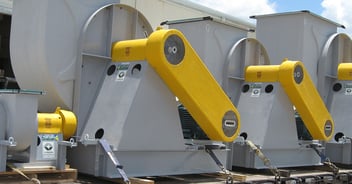
The defining characteristic of a centrifugal fan is how air moves through it. Air enters axially (straight in) and exits radially, turning 90 degrees through the housing. That geometry is what enables centrifugal designs to generate the sustained static pressure that industrial exhaust systems demand.
Standard HVAC fans move comfortable air through short, clean duct runs. Industrial exhaust systems are something else entirely. Long duct runs, fittings, scrubber resistance, and vertical stack discharge accumulate into system pressure that an undersized fan cannot overcome. The centrifugal design — large housing, air in, 90-degree turn, air out — handles that. It moves high volumes against real resistance without the efficiency collapse you'd see from an axial fan pushed past its design point.
That's the reason it's the default for industrial exhaust. Not marketing. Physics.
The inline centrifugal fan earns its place in space-constrained installations. Straight-through geometry — no elbows needed to enter or exit. The same static pressure capability as a standard centrifugal, with a considerably smaller footprint. If you're retrofitting into an existing duct run where there's no room to swing a full housing, that's the conversation.
When Radial Blowers Are the Right Call
Centrifugal fans excel at efficiency and quiet operation, two properties that depend on consistent, relatively clean airstream conditions. Introduce particulates or aggressive chemistry into that airstream, and the efficiency advantage disappears as wheel surfaces degrade. Faster than you'd expect.
That's where radial blowers earn their place. The paddle-style wheel design is deliberately primitive by comparison. No aerodynamic finesse. Heavy-duty construction, wide-open blade geometry, built to shed material rather than accumulate it. Radial blowers sacrifice some efficiency in exchange for survivability in dirty, corrosive conditions. They can achieve higher CFMs at higher static pressure than conventional centrifugal designs when the airstream is genuinely aggressive.
In high-tech manufacturing — particularly applications involving chemical etching, plating, or solvent-based processes — the choice between a centrifugal fan and a radial blower isn't about preference, but what the exhaust chemistry will actually do to your equipment over time.
Material Selection Is Not Optional
Most plant managers understand corrosion-resistant ductwork. Fewer apply the same scrutiny to fan construction material. Which is where expensive mistakes live.
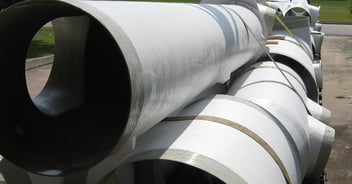
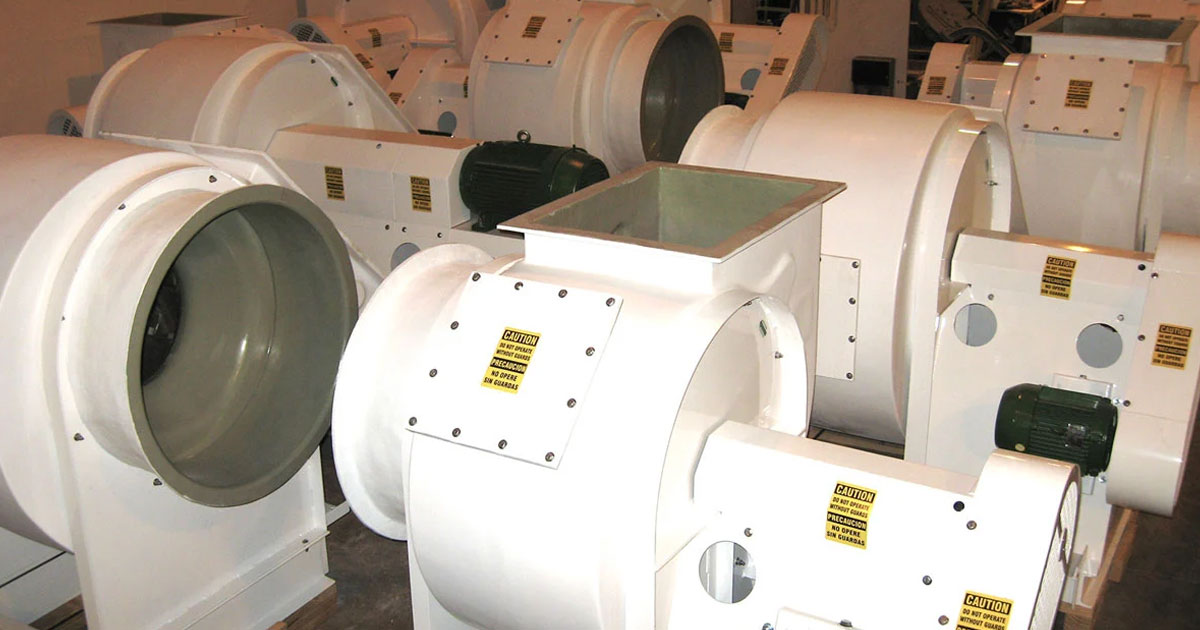
Fans handling corrosive exhaust must be built from materials compatible with that exhaust chemistry. Fiberglass fans handle a wide range of aggressive chemical environments and are commonly specified for FRP duct systems. PVC fans serve specific lower-temperature applications in metal plating, metal finishing, and process exhaust where the chemistry profile fits. Neither material is universal. The selection depends on what you're actually moving through the fan.
The failure mode when material selection is wrong is slow, then sudden. Surface degradation occurs over months. Then, a wheel failure during a production run you couldn't afford to interrupt.
The chemistry drives the material decision. Full stop. Vendor qualification follows from there, not the other way around.
AMCA Certification: What It Means and Why It's the Floor
AMCA (the Air Movement and Control Association) certifies fans based on independently verified performance testing. An AMCA certification on an industrial centrifugal fan tells you that the rated airflow and static pressure were confirmed by a third party, not just stated by the manufacturer on a spec sheet.
For facility managers in high-tech manufacturing, that distinction is significant.
Process exhaust systems are designed around expected airflow volumes and system resistance values. If the fan you spec delivers 15% less than its rated CFM at system static pressure, your scrubber doesn't operate at design efficiency, your hoods lose capture velocity, and your facility may be operating out of compliance without knowing it immediately.
AMCA certification doesn't guarantee a fan is right for your application. But it does confirm that the performance numbers on the data sheet are real. That's the minimum standard worth accepting.
The Static Pressure Problem Nobody Talks About Enough
Fan sizing in industrial exhaust systems fails more often than it should for one specific reason: the fan is sized based on assumed system resistance rather than actual calculated system resistance.
Every element in the exhaust path creates pressure drop — duct length, elbows, transitions, branch connections, the scrubber itself, discharge stack height, and stack effect. Those values are not interchangeable estimates. They vary by specific duct geometry, actual scrubber model, and real installation conditions.
When a fan is sized against generic pressure drop assumptions, the actual system will almost always present higher resistance than the design assumed. The fan gets pushed to the left of its design point on the fan curve — lower CFM, working harder against resistance it wasn't sized for. Capture efficiency at hoods decreases. The system underperforms, and the finger-pointing begins.
The fan supplier questions the ductwork, the duct fabricator challenges the scrubber specs, and the scrubber vendor points back at fan capacity.
It’s a solvable problem, though. But only if sizing is done against the actual complete system resistance — not assumptions built from someone else's generic duct tables. That calculation requires knowing every component: the real scrubber pressure drop, the actual duct layout, the stack height.
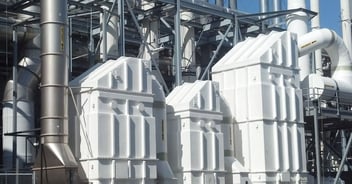
Single-source system procurement (one manufacturer designing ductwork, scrubber, and fan together) eliminates this failure category by design. Multi-vendor configurations cannot. The math only closes when one team owns all of it.
What Plant Managers Should Require from Any Fan Specification
Before signing off on a fan specification for a high-tech manufacturing exhaust system, four questions deserve direct answers.
- Is this fan AMCA certified for the rated operating conditions? Not "tested to similar standards." AMCA certified. That's the floor, not a differentiator.
- Can the vendor document material selection against your specific exhaust chemistry, not a general corrosion-resistant claim on a data sheet?
- Was this fan sized against the actual total system static pressure, including the scrubber pressure drop, or against a generic assumption? Those aren't the same number. They're often not close.
- Who is accountable if the airflow at startup doesn't match the design? If that question produces a complicated answer involving multiple vendors, the system has a structural problem before a single bolt is turned.
Choosing a Fan Manufacturer With System Engineering Capability
There is a real difference between a fan manufacturer and a system manufacturer that makes fans. And you find out which one you hired about three weeks after startup, when airflow doesn't match design. The former sells a component and hands off responsibility at the shipping dock. The latter designs a fan against the actual operating conditions of a complete exhaust system — duct resistance, scrubber pressure drop, stack conditions — and takes accountability for what the system actually does.
We've seen both outcomes. The finger-pointing conversation between three vendors trying to explain why CFM is 20% below spec is not a conversation anyone wants to be managing during commissioning.
For high-tech manufacturing applications where process exhaust chemistry is aggressive, airflow requirements are non-negotiable, and production continuity is on the line, the system-level approach is worth the additional scrutiny during vendor selection.
The fan will perform as designed only if it was designed against the real system.
The Viron Approach to System-Level Engineering
Viron International Corporation manufactures a full line of AMCA-certified industrial centrifugal fans, inline fans, radial blowers, and push-exhaust blowers, along with the ductwork, wet scrubbers, and dampers they connect to. Every fan specification we provide is calculated against the real static pressure of the complete system, not a generic assumption. If you're evaluating fan options for a corrosive air-handling application, the conversation starts with the system, not the component.
Viron International Corporation has designed and manufactured custom industrial air cleaning systems for more than 50 years. Our engineering team averages 25+ years of experience across semiconductor, municipal, industrial, chemical, aerospace, and pharmaceutical applications.
Don't leave your airflow to generic assumptions. Contact Viron’s engineering team today for a comprehensive system resistance review, or request a custom specification quote.
Frequently Asked Questions
How do I know whether my application needs a centrifugal fan or a radial blower?
The primary decision factor is airstream condition. If your exhaust is relatively clean (low particulate load, moderate chemical content), a centrifugal fan delivers better efficiency and quieter operation. If your exhaust carries significant particulate matter, sticky process residues, or highly corrosive vapors that would degrade aerodynamic wheel surfaces, a radial blower's heavy-duty paddle design is more durable in service. A secondary factor is required static pressure: radial blowers can achieve higher CFMs at higher static pressure than comparably sized centrifugal fans when conditions demand it.
What is the practical consequence of a fan that's undersized for system static pressure?
The fan will operate left of the intended design point on the fan curve. In practical terms: reduced airflow through the system, diminished capture velocity at hoods, potential scrubber performance degradation, and possible regulatory compliance issues. Depending on how significantly the fan is undersized, the facility may need to slow production rates or operate with reduced process tool density until the fan is corrected. Replacement mid-project is considerably more expensive than accurate initial sizing.
Can a standard industrial fan be used in a corrosive exhaust system if it's coated?
Coating a standard fan for corrosion protection is not equivalent to manufacturing a fan from corrosion-resistant materials. Surface coatings applied to carbon steel or standard alloy fan wheels can fail at joints, welds, and leading edges — exactly the points subject to the highest velocity impact from the exhaust stream. For sustained service in genuinely corrosive environments, fans built from fiberglass or appropriate thermoplastic materials throughout construction (wheel, housing, inlet cone) are the more defensible specification.
Does AMCA certification cover the specific installation conditions in my facility?
AMCA certification confirms fan performance at rated conditions under standardized test setups. It does not verify performance in your specific system configuration, elevation, or inlet conditions. This is why fan selection must account for site-specific factors — installation elevation effects on air density, inlet ductwork geometry that may reduce effective inlet area, and the actual system resistance your installation presents. AMCA certification is the necessary starting point, but it doesn't substitute for system-specific engineering review.
What's the difference between an inline centrifugal fan and a standard centrifugal fan in terms of when to use each?
A standard centrifugal fan requires the airstream to enter axially and exit radially, meaning the fan housing is a distinct piece of equipment outside the duct run. An inline centrifugal fan routes the air in a straight line through the unit, maintaining duct alignment and eliminating the need for elbows to transition into and out of the fan. The inline design saves space and reduces installation complexity, particularly in retrofit situations or facilities with constrained equipment layouts. Performance capability is comparable. The choice is largely driven by available space, duct routing constraints, and whether the additional elbows required by a standard centrifugal fan would add meaningful pressure drop to the system.