Industrial Centrifugal Blower Selection: CFM, Static Pressure, and Efficiency Explained
Summary
Fan curves that are sized against estimated system resistance fail—even when the underlying CFM calculation was correct. In a corrosive exhaust application, the static pressure data behind any blower selection has to reflect real component performance: the scrubber's actual pressure drop, the ductwork's true resistance, the operating conditions as they exist rather than as they were assumed. A correctly specified fan matched to the wrong numbers is still the wrong fan.Get the blower wrong and everything downstream suffers. The scrubber underperforms, pressure drops exceed design, and by the time the FRP air duct is running negative pressure it wasn't sized for—flanges leaking, startup schedule slipping—the problem traces back to a fan curve nobody validated against the actual system.
That's what bad blower selection costs you. Not just the fan itself, but the whole system.
Key Takeaways
- The air volume your blower sees at the inlet is often not what was calculated on paper. Design to the high end of your CFM range, not the midpoint—and build in margin for the variables that will move it in operation.
- A generic scrubber pressure drop estimate may differ significantly from your scrubber's actual pressure drop. Fan sizing that uses the estimate instead of the real figure produces a blower that was correctly sized against the wrong input—and that's a mismatch you often don’t discover until startup.
- Fan efficiency compounds over time. In a 24/7 exhaust system, the wrong wheel design shows up on the utility bill long before it shows up as a maintenance problem.
- Multi-vendor sourcing creates an accountability gap that no contract can fully close. When each component is specified independently, system underperformance has no single owner.
- AMCA certification confirms the fan performs to its published curve. Matching that curve to your real system resistance—not a catalog estimate—is still your responsibility, and it's where the selection either holds or falls apart.
CFM: Volume Is Only Half the Calculation
CFM (cubic feet per minute) tells you how much air the blower needs to move. In a corrosive exhaust application, you need the total CFM coming off every process tool, every hood, every branch in the duct system before you can size anything.
Where engineers get into trouble is assuming the design CFM will appear at the fan inlet exactly as calculated. Changes in hood capture requirements, duct leakage and modifications, and air-density shifts with temperature can all move the real operating point away from that neat design value.
You need to build in margin. Select a fan that can comfortably reach the upper end of your expected CFM band—with appropriate safety factor on both flow and pressure—and use controls to dial it back, rather than sizing a fan whose ‘just-right’ midpoint assumes the system never leaks, changes, or drifts.
Static Pressure: The Variable Most Specs Underestimate
Static pressure is the resistance the blower has to overcome to move air through the system—ductwork, fittings, scrubber internals, stack exit, everything—typically expressed in inches of water gauge (in. w.g.). That’s where many blower selections go sideways.
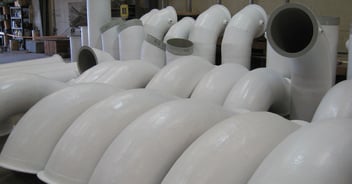
The catch is that accurate static-pressure calculations require realistic data for every component. The pressure drop across a wet scrubber is not a generic catalog value; it depends on that scrubber’s packing, liquid distribution, and operating liquid rate. A fiberglass reinforced plastic duct run with multiple elbows and long horizontal sections has significantly higher resistance than a short, straight vertical stack. Neither number is generic.
If you’re sourcing your fan from one vendor and your scrubber from another, you’re often asking each party to calculate system resistance using assumptions about the other’s equipment. That’s how you end up with a blower that was correctly sized—for the wrong static-pressure number.
The fan has to be sized against the real system pressure drop. Not an estimated one.
Efficiency: What It Costs You to Run the Wrong Fan
Every hour a fan runs away from its best‑efficiency point, it costs you more power for the same airflow. In a 24/7 industrial exhaust system, that’s not a rounding error, but a line item that compounds across years of operation.
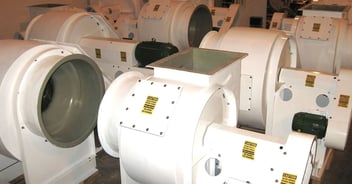
Centrifugal fans—large housings, air comes in and turns 90° out—offer one of the highest efficient-quietest operations of any fan manufactured. That’s the right call for high-volume, continuous exhaust where energy consumption matters and noise is a real operational concern.
Radial blowers are built differently: paddle-style wheels, heavy-duty construction, designed specifically for corrosive and particulate-laden airstreams. They can achieve higher CFMs with higher static pressure than conventional fans. They are more durable in aggressive service, but less efficient in steady-state operation.
Most specs lead with purchase cost and treat efficiency as an afterthought. That’s backwards. A fan mismatched to the application (oversized, undersized, or with the wrong wheel design for the airstream) starts charging you on the utility bill from day one, long before the maintenance log shows what that mistake really costs.
Fan Type, Duct Material, and the Multi-Vendor Problem
Here's a scenario that plays out more than it should: a centrifugal blower is selected for a corrosive exhaust system, the FRP air duct is fabricated by a separate vendor, and the scrubber comes from a third. The fan was sized correctly—against the designer's estimate of total system resistance. The fiberglass reinforced plastic ductwork was fabricated to the right diameter. The scrubber was engineered to spec.
Then startup happens. Airflow doesn't match design. Pressure across the scrubber runs higher than spec. There's a negative pressure condition on a duct section nobody accounted for.
Now the fan manufacturer questions the FRP ducting resistance calculations. The duct fabricator challenges the scrubber's actual pressure drop. The scrubber manufacturer questions whether the fan is operating at the right point on its curve. Everyone's data is technically defensible in isolation. The system still doesn't work.
This is the multi-vendor sourcing problem, stemming from a lack of accountability. When each component is specified independently, there's no single party that owns complete system performance.
AMCA Certification: What That Means
AMCA-certified fans have been independently tested and verified to perform to published ratings. The fan curve is a documented performance characteristic confirmed through third-party testing, rather than a manufacturer's estimate.
That matters in corrosive applications because you're not selecting a fan for day-one performance only. You need it to perform as specified over years of continuous operation in a chemically aggressive environment. AMCA certification is the baseline credential. Material selection fiberglass construction for corrosive airstreams—is what keeps it performing.
How Viron Approaches Blower Selection
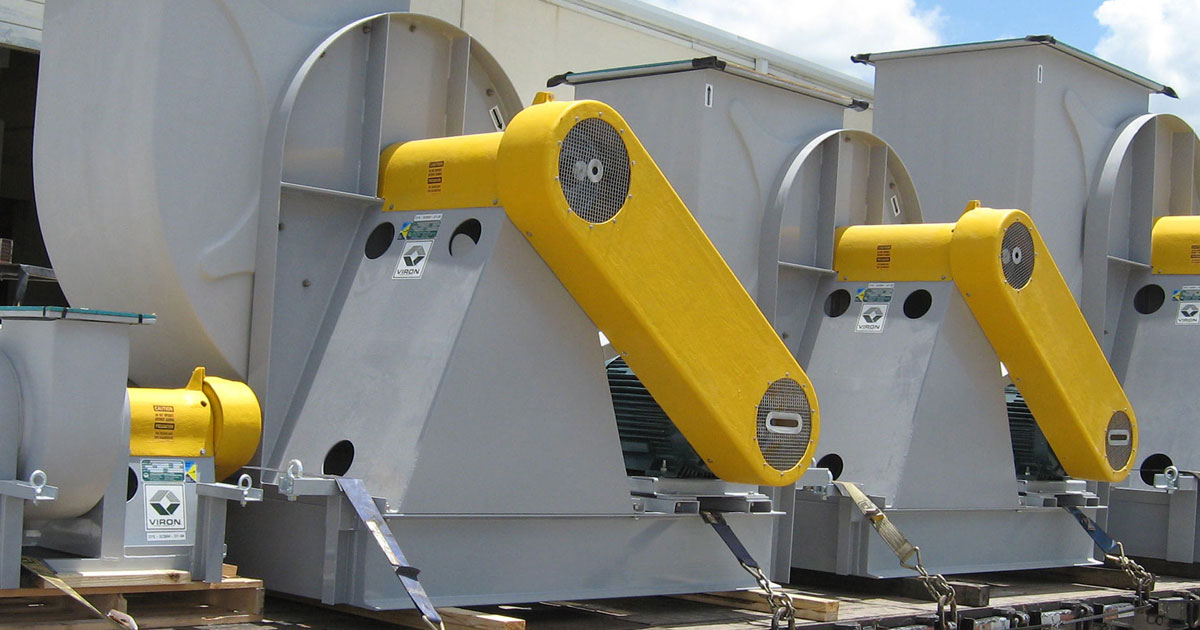
Viron manufactures a full AMCA-certified fan line built for corrosive air exhaust applications. When we're involved in the system design, the fan curve is matched to actual scrubber performance, not a generic pressure drop estimate. The FRP air duct resistance, the scrubber internals, the stack configuration—all of that goes into the sizing calculation before a single component is manufactured.
We've done this for major industry players, for applications where the system had to perform to spec from day one and multi-vendor finger-pointing wasn't an option.
If you're specifying a centrifugal blower for a corrosive exhaust system and want to run the application by us, that conversation typically takes about 15 minutes. We'll tell you what the system needs—and where the common sizing assumptions break down for your specific chemistry and layout. Contact Viron to set up that conversation.
Frequently Asked Questions
How do you decide between a centrifugal fan and a radial blower for a corrosive exhaust application?
Airstream condition is the deciding factor. Centrifugal fans are the right call when the exhaust is relatively clean and continuous (semiconductor fab general exhaust, for example), where efficiency and quiet operation matter. Radial blowers are built for airstreams carrying particulate, condensate, or aggressive chemistry that would damage a conventional wheel over time. The durability trade-off is real: radial blowers run less efficiently, but in a corrosive or dirty application, a centrifugal fan's efficiency advantage disappears quickly if the wheel degrades.
What happens when a fan is oversized for the system?
An oversized fan doesn't just waste energy, but destabilizes the system. Running too far left on the fan curve puts the blower in an unstable operating region where airflow becomes erratic, motor load fluctuates, and the fan can surge. In a corrosive exhaust system connected to fiberglass reinforced plastic ductwork, pressure instability stresses joints and flanges in ways that steady-state negative pressure doesn't. You may not see a failure immediately, but you're accelerating wear on every sealed connection in the system.
If we're adding a scrubber to an existing exhaust system, do we need to re-evaluate the fan?
Almost always, yes. A scrubber adds significant static pressure to the system; the pressure drop through packing media, liquid distribution, and the scrubber body itself can run several inches of water gauge, depending on the unit. If the existing fan was sized for ductwork resistance only, it likely doesn't have the capacity to overcome the additional load. The result is reduced airflow across the scrubber, which directly degrades removal efficiency. Before any scrubber is added to an existing system, the fan curve needs to be checked against the new total system resistance.