
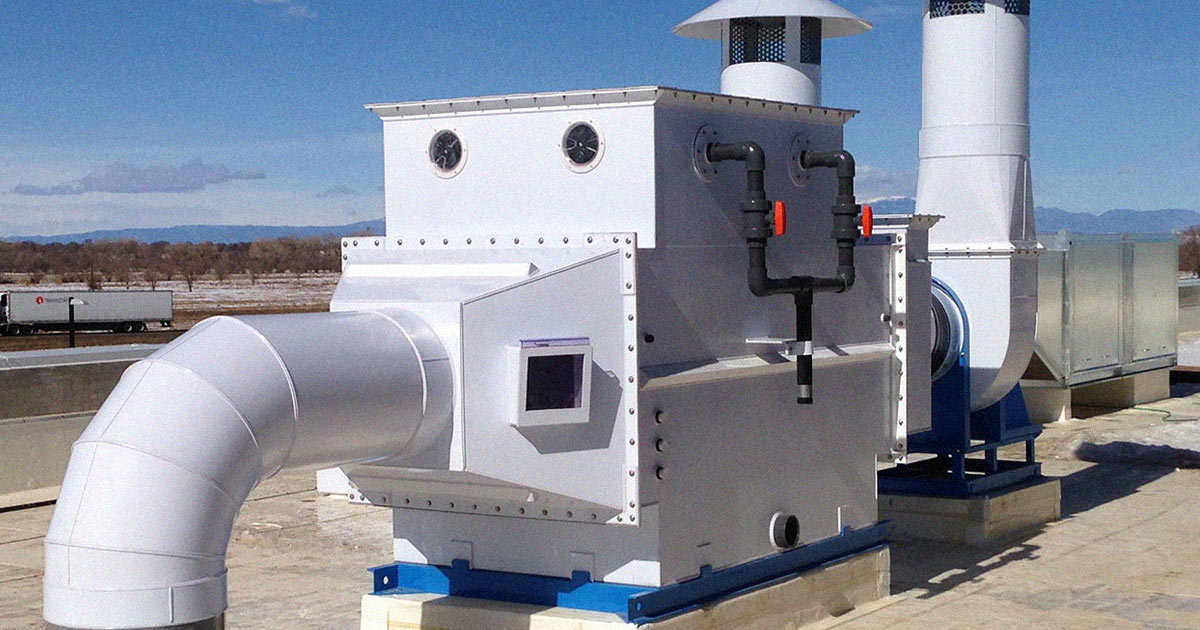
Wet Air Scrubbers: Handling High-Volume Corrosive Exhaust
Summary
A wet air scrubber removes corrosive gases from exhaust by passing the air through packing wetted with a scrubbing liquid. The mass transfer principle holds at any size, but packing face area, recirculation flow, duct diameter, and roof load all grow with airflow. At a 500 FPM packing velocity, a 50,000 CFM stream needs about 100 square feet of packing face and roughly 400 GPM of recirculation at 4 GPM per square foot.
A plating line scrubber moving 5,000 CFM and a fab exhaust scrubber moving 50,000 CFM work the same way. Contaminated air passes through wetted packing, the acid or ammonia transfers into the scrubbing liquid, and cleaner air leaves through the mist eliminator. The chemistry doesn't care how big the unit is.
However, the equipment around the chemistry cares a great deal.
Standard wet scrubbers range from 500 CFM to 100,000 CFM. At the upper end of that range, the decisions that separate a good system from a troublesome one rarely involve the mass transfer principle. They involve footprint, liquid handling, roof load, duct diameter, and how a unit that ships in sections gets reassembled and started up.
Key Takeaways
- A wet air scrubber works on the same mass transfer principle at 500 CFM or 100,000 CFM. Packing face area, recirculation flow, roof load, and duct diameter all grow with the airflow.
- At a 500 FPM packing velocity, a 50,000 CFM stream needs roughly 100 square feet of packing face and about 400 GPM of recirculation at a standard 4 GPM per square foot.
- Integrated blower-scrubbers top out at 15,000 CFM. Above that, the choice is horizontal or vertical, and horizontal units carry higher operating costs from a larger pump and motor.
- High-volume mains can reach 120 inches in diameter. SSTeelcoat® stainless steel and fiber-reinforced plastic (FRP) are built to that size; PVC stops at 96 inches.
- Large scrubbers ship in pre-plumbed, water-tested sections, which cuts field assembly time and gets the system to startup faster.
What Stays Constant in a Wet Air Scrubber
Every wet scrubber exposes contaminated air to a scrubbing liquid, usually water or a chemical solution, through sprays and packed media. The liquid absorbs or reacts with the pollutant. Cleaned air exits, and the solution is recirculated, treated, or blown down.
Two design numbers anchor this process.
- Packing velocity: Air moves through the packing at 400 to 600 feet per minute.
- Liquid loading: Liquid is pumped over that packing at 2 to 15 GPM per square foot of open surface area, and Viron's standard units run at 4 GPM.
Our packed bed scrubber guide covers how contaminants move from the air into the liquid inside the bed.
Those numbers are set by physics. So everything else has to grow.
Packing Face Area Scales With Airflow
Hold the packing velocity at 500 FPM and do the division. A 5,000 CFM stream needs about 10 square feet of packing face. A 50,000 CFM stream needs about 100.
At 4 GPM per square foot, recirculation climbs from roughly 40 GPM to roughly 400 GPM. Ten times the liquid crosses the spray headers, and the recirculation pump and sump are sized to match. Viron sizes process piping for about 6 feet per second, which keeps pressure drop and pump horsepower in balance.
Wetting gets harder to get right as the bed gets wider. The polypropylene packing Viron uses (Jaeger Tri-Packs®, Lantec Lanpac®, or Rauschert, depending on the application) is geometric, so the pieces don't nest. When packing nests, dry areas form, and contaminants slip through the open channels and efficiency drops. Then static pressure climbs too, which means more fan energy to push air through the column.
That phenomenon across 100 square feet of packing face means a distribution problem is not a small issue.
Removal efficiency adds a second axis. Standard packing depth runs from 12 to 180 inches, and Viron increases depth in specific applications to reach higher efficiencies. A deeper bed removes more contaminant and adds resistance, so the efficiency target and the fan selection get settled together.
Horizontal or Vertical at High Volume
The first option to drop out is the integrated blower-scrubber. Viron's VBS series tops out at 15,000 CFM, so a high-volume corrosive exhaust stream goes to either a VHS horizontal unit or a VVS VIR-TI-CAL™ vertical unit.
Vertical towers stack the packing and conserve floor space. Horizontal crossflow units spread out, which keeps spray headers within reach without tall ladders and suits rooftop installations.
We'll be direct about the trade-off here. Horizontal scrubbers carry higher operating costs because they need a larger pump and motor. The easier access is real. So is the utility bill. If a rooftop layout defaults to horizontal, price that pump difference before the layout gets approved.
Where the Recirculation System Lives
Self-contained units mount the pump on top of a sump attached to the scrubber housing. They fit warm climates and indoor installations where freezing is rare.
Remote recirculation moves the pump to a separate tank inside the building. For a large rooftop scrubber in a cold-winter region, that removes liquid weight from the roof, eliminates freeze risk, and drops the need for scrubber heaters. Some facilities also like being able to watch the recirculation flow without climbing onto the roof.
Secondary containment follows the consequences of a leak. A unit sitting in a concrete well may need none. Others need a containment pan. Full encapsulation builds a shell around the entire plumbing assembly, so a leak at any fitting stays inside the unit. A backup recirculation pump is also on the spec sheet for facilities that can't lose flow during service.
Same Physics. Ten Times the Air.
What changes when a wet air scrubber scales from 5,000 to 50,000 CFM
Every Viron scrubber is fully plumbed and water-tested before it ships.
The Ductwork Gets Big, Too
A 100,000 CFM scrubber needs duct to match. Semiconductor fabs run exhaust from tool hookup through laterals to building mains, and Viron manufactures SSTeelcoat coated stainless steel duct from 4 inches up to 120 inches to cover that entire run. FRP ductwork is built to the same diameters. However, PVC stops at 96 inches, which can rule it out for the largest mains.
SSTeelcoat pairs 304 or 316 stainless with a Halar® ECTFE fluoropolymer interior coating, carries FM 4922 Approval, and handles roughly 300°F continuously. FRP reaches a Class 1 flame rating with select resins but produces more smoke, and it remains a strong fit for scrubber yards and lower-concentration gas streams. We manufacture both every week. Vendors who only manufacture one material option have limited ability to make that call honestly.
(Our SSTeelcoat vs. FRP ductwork ROI comparison runs through the lifecycle numbers for you.)
Municipal plants have historically defaulted to fiberglass, although one major city water system client of ours recently went with coated stainless throughout its expansion, and other large municipalities are starting to weigh the same switch.
The fan closes the loop. Viron's AMCA-certified fans are sized to the static pressure drop across the scrubbers we build, because we have those numbers from the start.
Getting a Large Scrubber Installed and Running
Big scrubbers don't ship in one piece. Viron breaks larger units into pre-assembled sections with gasketed, flanged piping connections; the contractor sets the base, bolts on the middle section, connects the plumbing, and sets the top.
Before breakdown, every scrubber is fully plumbed and filled with water so pumps, valves, and sensors are tested in our shop. Larger units get shrink-wrapped for transit and storage, since scrubbers don't always go straight from the truck to the pad. Contractors who visit the plant to see their unit assembled before shipment find their field installation runs smoother and faster.
On a 100,000 CFM job, that's a worthwhile day trip.
Many scrubber suppliers ship the body and leave the plumbing to the installing contractor. We don't. Viron's in-house controls engineer programs the system, and our team supports startup on site.
That approach holds whether the exhaust comes from a plating or anodizing line, steel pickling, a pharmaceutical process, a wastewater odor control building, or a semiconductor fab.
What to Send Before the First Call
The fastest way to get a high-volume chemical scrubber scoped correctly is to bring the design data:
- Inlet gas flow in ACFM
- Loading rate of each contaminant in ppm or pounds per hour
- Gas temperature
- Required removal efficiency
- Indoor or outdoor location
- Horizontal or vertical preference
- Remote or self-contained recirculation
- Secondary containment requirements
Leave one out and your entire system gets sized on an assumption.
If you're speccing a corrosive air system at this scale and want to talk through the application, that's the conversation we're built for. For more than 50 years, Viron has engineered and manufactured custom industrial air cleaning systems for corrosive and odorous environments.
Contact Viron today for a system consultation or to request a quote.
Frequently Asked Questions About Wet Air Scrubbers
How does a wet air scrubber keep scrubbing liquid from leaving with the clean air?
The mist eliminator catches entrained droplets before the air exits. Horizontal cross-flow blades remove 99% of 20-micron droplets, and vertical counter-current blades reach 99% at 32 microns. Composite mesh pads capture 99% of droplets down to 3 microns. Finer capture usually means added height and pressure drop, so the mist eliminator gets selected alongside the fan, not after it.
Can Viron build a wet scrubber larger than 100,000 CFM?
Yes. Viron's standard wet scrubbers run from 500 to 100,000 CFM, and our engineering team quotes and manufactures custom units on request. Units below 500 CFM are available too. For anything outside the standard range, the same design data applies: ACFM, contaminant loading, temperature, and required removal efficiency.
Can one chemical scrubber treat more than one contaminant?
Often, yes, depending on the chemistry. Viron's design data asks for the loading rate of each contaminant in the airstream, and chemical neutralization systems are available with pH, ORP, or TDS control. Whether a single unit can handle the full mix depends on the chemistry involved. Our engineering team makes that call from your process data.
What are Viron scrubber housings made from?
Viron scrubber housings are built from PVC, polypropylene, FRP, or PVC with an FRP overlay. FRP housings use chemical-resistant vinyl ester resin (VER 9300 or as specified) with an inner corrosion barrier reinforced with surface veil. Recirculation pumps are CPVC as standard, with FRP, stainless steel, and polypropylene available.