
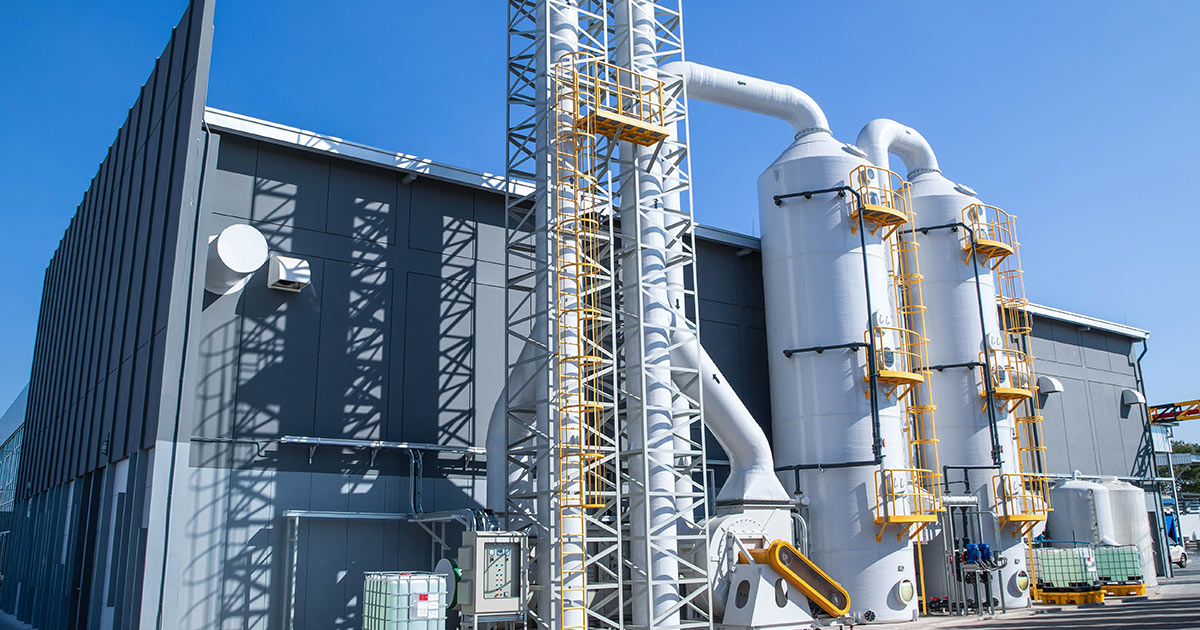
Using Ammonia Scrubbers for Emissions Control
Summary
Ammonia scrubbers commonly use acid-dosed solution to neutralize ammonia and maintain removal efficiency beyond what plain water alone provides, sized by four numbers—airflow, loading rate, temperature, target efficiency—with materials matched to ammonia's form. Most failures trace to chemistry drift, so monitoring between stack tests verifies performance; the piece ends with a consultation CTA.These are the chemistry, sizing inputs, and material choices that determine whether an ammonia scrubber maintains its removal efficiency.
Ammonia dissolves in water almost too easily. That's the good news, and the bad news. It means a wet scrubber can pull ammonia out of an exhaust stream efficiently, but only if the chemistry inside that scrubber is doing the real work water alone can't finish. Skip that chemistry and the compliance number just quietly slips. It won't look broken. It'll just quietly stop hitting its target.
Getting that right starts with understanding what the chemistry is doing inside the scrubber, not just where the water goes.
Key Takeaways
- Ammonia's the easy part chemically—it's extremely water-soluble—but plain water only gets you so far. Acid-dosed scrubbing solution pushes removal efficiency into the compliance range.
- Design starts with four numbers: airflow (ACFM), ammonia loading rate, inlet temperature, and required removal efficiency. Skip any one and the scrubber is sized on guesswork.
- Ammonia shows up in three different forms: gas, anhydrous liquid, and aqueous ammonium hydroxide. And each one has a different material compatibility profile.
- A rising outlet ammonia reading with stable airflow often points to reagent underfeed or pH drift rather than a mechanical failure. It's worth checking chemistry before assuming a part broke.
- Ammonia scrubbing isn't one industry's problem. Wastewater odor control, refrigeration releases, fertilizer and chemical processing, and metal finishing all generate ammonia that needs the same core chemistry to remove it.
How Does an Ammonia Scrubber Remove Ammonia from an Airstream?
An ammonia scrubber exposes contaminated air to an acid-based scrubbing solution—typically dilute sulfuric acid—that reacts with ammonia gas to form a stable, water-soluble salt. That reaction is what pushes removal efficiency into compliance range. Water alone can absorb a meaningful amount of ammonia—plenty of odor-control systems run on it—but it won't get you to the removal numbers a tighter permit limit demands.
Plain water absorbs ammonia reasonably well on its own, which is exactly why plenty of systems get underdesigned. Ammonia is a base. Add an acid to the recirculating solution, and it neutralizes on contact, forming ammonium sulfate instead of dissolved ammonia sitting in equilibrium with the airstream above it. That reaction pulls the concentration gradient in the right direction and keeps absorption capacity from saturating as fast as plain water would.
The mechanical side does its job by maximizing contact between gas and liquid; packed media or spray distribution force the airstream through a wet, high-surface-area path so the reaction has somewhere to happen. Skip the packing, or let it foul, and the chemistry still works.
It just doesn't get the contact time it needs to matter.
Contact pattern matters, too.
- A counter-current design—liquid falling through the packing while gas rises against it—keeps the freshest, least-saturated scrubbing solution meeting the airstream right before it exits, which is where the last, hardest-to-remove traces of ammonia get pulled out.
- A cross-flow arrangement trades some of that efficiency for a lower pressure drop and a smaller footprint.
Neither is universally correct. It's a trade-off the application dictates, rather than a default.
The Four Numbers That Size an Ammonia Scrubber
Ammonia scrubber sizing comes down to four numbers:
- Airflow (ACFM)
- Ammonia loading rate
- Inlet temperature
- Removal efficiency the permit or process requires
Everything else—packing selection, recirculation rate, materials—gets built around those four.
Loading rate matters more than concentration alone. A low-ppm stream at high volume can carry more total ammonia mass per hour than a strong stream at low flow, and the scrubber has to be sized to the mass loading, not just the percentage.
Material selection is where ammonia gets more complicated than people expect. Ammonia gas and anhydrous liquid ammonia are the same compound in different physical states, but aqueous ammonium hydroxide—ammonia already dissolved in water—is a genuinely different mixture, and all three behave differently against a given material as concentration and temperature climb. "What handles ammonia" isn't a single answer. It depends on which form, at what concentration, and at what temperature.
Instrumentation carries real weight, too. A pH controller manages the acid feed doing the neutralization work. A conductivity controller tracks dissolved-salt buildup and can trigger blowdown before the solution gets too loaded with ammonium salts to keep absorbing effectively. (ORP shows up on scrubbers handling oxidizing chemistry—it doesn't have anything to measure in a straightforward acid-base ammonia reaction.)
Recirculation rate and sump volume matter for a related reason. A larger reservoir of scrubbing solution takes longer to saturate, which buys time between blowdown cycles, but it also means a slower response if the chemistry needs correcting. And any system handling liquid ammonia deserves a real answer on secondary containment, not just the scrubber housing—the design should address leak detection, containment, and drainage for a liquor that may carry residual acid and ammonium salts.
Ammonia Emissions Aren't One Industry's Problem
Wastewater treatment releases ammonia as a decomposition byproduct alongside hydrogen sulfide. Industrial refrigeration systems run on anhydrous ammonia and need abatement for leaks and purge streams. Fertilizer, chemical processing, and metal finishing operations generate it directly from process chemistry. Livestock and food processing operations add ammonia to that list too, generated biologically rather than chemically—which is exactly why the same core chemistry ends up solving problems that look nothing alike on paper.
The core scrubbing chemistry doesn't change much across those applications.
Acid-dosed liquid contacts the airstream, and neutralization keeps free ammonia in the liquid low enough to sustain the absorption driving force—that matters more than raw solubility. What changes is concentration, flow rate, and how much redundancy the application demands. A refrigeration purge event looks nothing like a steady-state wastewater odor stream, even though the same acid-scrubbing principle handles both.
Design Efficiency vs. Demonstrated Efficiency
Design efficiency and demonstrated efficiency aren't the same thing, and the only way to know which one you have is to measure it. Periodic stack testing against the permitted outlet concentration is the standard verification method, but it's just a snapshot—it tells you how the scrubber was performing on the day of the test, not every day since.
Continuous parameter monitoring closes that gap. Tracking pH, recirculation flow, and differential pressure against the values that produced a passing stack test gives you a proxy for performance between test dates. If those parameters hold, that's a good sign removal efficiency is holding too—though it's a correlation, not a guarantee; a probe can read stable while packing fouls or gas bypasses it.
If pH has drifted for three weeks and nobody caught it, the next stack test is the expensive way to find out.
How an Ammonia Scrubber Works
The Chemistry
Neutralization forms ammonium sulfate — reaction, not just solubility, drives removal efficiency.
The Four Sizing Inputs
Ammonia's Three Forms, Three Compatibility Profiles
Same compound, different material question — compatibility shifts with concentration and temperature.
What Usually Trips Up Ammonia Scrubber Performance?
A common category of ammonia scrubber problems traces back to chemistry drift rather than mechanical failure. An outlet concentration that climbs while airflow stays steady is worth checking against reagent feed and pH before assuming something broke.
The most common mistake happens at the design stage, not in operation. That may look like sizing a scrubber as if plain water absorption were the whole story, then wondering why it underperforms once real inlet loading runs higher than test conditions assumed. More packing isn't automatically the fix. Confirm the acid feed rate was sized to the actual mass loading first—if that's already right, packing depth, distribution, and contact time are the next things to check.
In operation, a pH probe that's drifted out of calibration will let the reagent feed run wrong for weeks before anyone notices, because the scrubber keeps running and doesn't look obviously broken. It just quietly removes less ammonia than it's supposed to.
Corrosion is the other one worth watching. Ammonia's compatibility with a given material shifts with concentration and temperature, so a process change upstream that increases either one can turn a previously fine material choice into a maintenance problem.
Ammonia scrubbing looks simple from the outside; spray some water, catch the gas. The systems that hold their scrubber efficiency over years of service are built around the specific chemistry, loading, and materials the application demands, not a generic scrubber with acid dosing bolted on after the fact. We design that system in-house, from the engineering that sizes the chemistry to the materials that survive it. That's the difference between a scrubber that passes its first stack test and one that still passes its fifth.
If you're speccing an ammonia abatement system, or trying to figure out why an existing one isn't holding its numbers, that's worth a conversation. Start with a system consultation.
If you're evaluating packed bed scrubbers for a corrosive exhaust application, contact our engineering team with your process data, and we'll give you a straight read on what the system actually needs. Contact Viron today or request a quote.
Does an ammonia scrubber need acid dosing, or will plain water work?
Plain water absorbs some ammonia, but capacity saturates quickly because there's no reaction pulling the concentration gradient in your favor. Acid dosing (typically dilute sulfuric acid) neutralizes ammonia on contact, which is what sustains removal efficiency at real-world loading rates rather than lab-test conditions.
How is anhydrous ammonia different from ammonium hydroxide for material selection purposes?
Anhydrous ammonia is a liquefied, highly concentrated form—most of it produced goes to fertilizer, with industrial refrigeration as another significant use; ammonium hydroxide is ammonia already dissolved in water. They behave differently against the same construction material, especially as concentration and temperature change—so a material spec written around one doesn't automatically transfer to the other.
What's a reasonable removal efficiency target for an ammonia scrubber?
That depends on your permit limits and inlet loading, not a fixed industry number. A scrubber sized for a lower efficiency target and one sized for a much tighter target look different in packing depth, recirculation rate, and acid feed capacity. Start from the number your permit or process requires, not an assumed default.
Can one scrubber handle both ammonia and acid gases in the same airstream?
Sometimes, if the chemistry is compatible and the design accounts for both loads, but combining contaminants changes the reagent chemistry, the pH setpoint, and potentially the removal efficiency for each individually. That's a system-specific design question, not a standard configuration.