Wet Scrubber Install Best Practices: What Facility Engineers Need to Know
What your manufacturer owes you before the truck leaves the dock, and what a smooth startup looks like.
Blog Summary: The installation problems that derail wet scrubber projects almost never start on-site. They start weeks earlier — in an incomplete specification, a factory that didn't test before shipping, or a contractor who arrived without ever seeing the unit assembled. This guide covers the full arc of a scrubber installation so you know where accountability should sit at every stage, and what to demand from your manufacturer before the truck leaves the dock.
Most installation problems with industrial wet scrubbers aren't installation problems. They're design problems. Or shipping problems. Or specification gaps that nobody caught until the contractor showed up on-site with a unit that doesn't quite match the drawings.
By the time a scrubber reaches your facility, the decisions that determine whether installation goes smoothly have largely already been made. That's worth understanding. Because it shifts accountability to an earlier stage in the process, and toward the right party: your manufacturer.
This guide covers the full arc of a wet scrubber installation, from the data your engineer needs before putting pen to spec sheet, through factory assembly, shipping, field reassembly, and startup. At each stage, there's a clear standard for what should happen and what commonly goes wrong when it doesn't.
Key Takeaways
- Eight specific data points — including inlet gas flow (ACFM), contaminant loading rate, temperature, and required removal efficiency — must be in your manufacturer's hands before a scrubber can be accurately designed or quoted.
- A scrubber that arrives fully pre-plumbed and factory water-tested requires significantly less on-site labor and removes compatibility guesswork about valves, pumps, and sensors.
- Large scrubbers shipped in pre-assembled, flanged sections, with all field connections as bolted unions, allow contractors to set, bolt, and connect without any field fabrication.
- A pre-shipment plant visit by the installing contractor is one of the highest-value, lowest-cost steps an engineer can require in the project schedule.
- On-site startup support from the manufacturer's own controls engineer (not a third-party vendor) is the difference between a clean commissioning and a prolonged debugging exercise.
It Starts With the Right Data
Before a corrosive exhaust scrubber can be accurately designed or quoted, your manufacturer needs eight things:
- Inlet gas flow (ACFM).
- Inlet loading rate of each contaminant (ppm or lb/hr).
- Airflow temperature.
- Required removal efficiency.
- Indoor or outdoor installation.
- Orientation — horizontal or vertical.
- Recirculation system — self-contained or remote.
- Secondary containment level — none, partial, or full encapsulation.
That last one matters more than most engineers expect. The answer to each of these questions changes the scrubber design — the vessel sizing, the packing depth, the pump selection, the piping configuration, the structural design for wind and seismic loads. An incomplete intake means an incomplete quote, and a quote built on assumptions tends to produce surprises on-site.
If your manufacturer isn't asking for all eight upfront, that's a flag.
Pre-Design Decisions That Affect Installation
Two configuration choices get locked in early and directly affect how the installation plays out in the field.
Recirculation system: self-contained vs. remote. Self-contained units mount the pump on the scrubber sump, the right call for warm climates and indoor installations. Remote systems locate the recirculation tank separately inside the building, which eliminates the risk of freezing and the need for scrubber heaters in cold-weather regions. The trade-off is more field piping. Climate and facility layout drive the decision.
Secondary containment level. A base containment pan catches leaks at the bottom of the scrubber, the industry standard and adequate for most applications. Full encapsulation is a different category. A fiberglass shell built around all process piping means any valve, fitting, or pump seal failure stays inside the unit and drains to the containment pan.
Access doors handle routine maintenance. Removable wall panels handle major work. It adds cost, roughly $30,000 to $40,000, depending on scrubber size. It also eliminates a category of safety and environmental risk the standard pan approach doesn't fully address. For applications handling aggressive acids or caustics, that trade-off deserves a direct conversation with your engineer, not a line item deleted in value engineering.
Factory Assembly and Testing: What Should Happen Before the Truck Loads
This is where a lot of industrial air pollution control projects quietly go wrong.
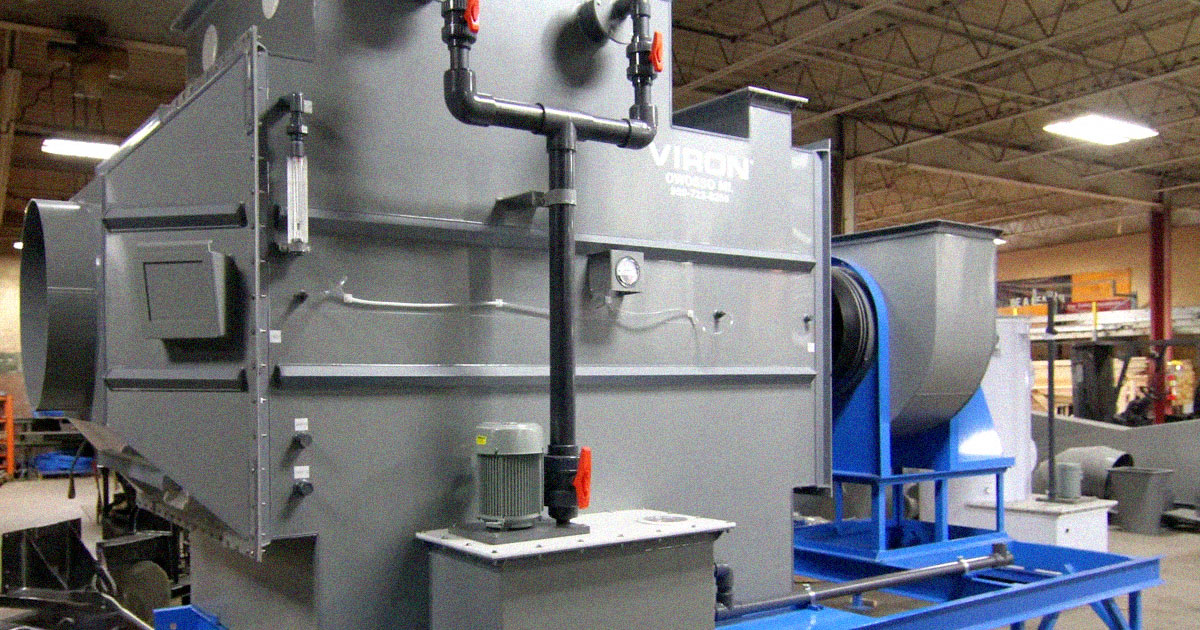
A Viron scrubber system (FRP, PVC, or SSTeelcoat-ducted), for instance, arrives completely pre-plumbed. Every valve, pump, and sensor is mounted and tested in our shop before we break the unit down for shipping. All field connections are flanged or union-type. The contractor doesn't do field fabrication on plumbing; they connect, bolt, and commission.
The alternative is common in the industry. Many manufacturers ship the scrubber body. The installing contractor handles all the plumbing on-site — sourcing compatible components, making field cuts, running their own leak checks. It extends the installation schedule, introduces compatibility questions that should have been resolved at the factory, and puts the performance risk on a crew that didn't design the system.
Factory water testing is the other step that matters here. Every Viron scrubber is filled with water and runs through a complete functional test before it leaves our facility. Every pump is operated. Every valve cycled. Every sensor verified. By the time that unit reaches your site, it has already worked. What remains is reassembly and connection to your system — not discovery.
Shipping: Protecting What You've Specified
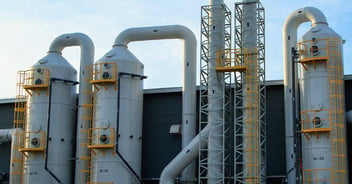
Large scrubbers ship in pre-assembled sections with all plumbing connections gasket-flanged at the break points. The contractor sets the base section, bolts the seam, connects the gaskets on the flanged piping, and sets the next section.
That's the sequence. No field welding. No cutting. No guessing about what connects where.
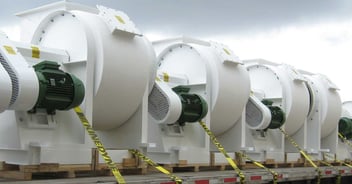
Shrink wrapping (the same material used to ship pontoon boats) protects fittings, gaskets, and exposed surfaces during transit and on-site storage. When a scrubber arrives in January in Michigan and sits on the dock for three weeks before the building is ready, that protection matters.
For PVC scrubbers, temperature during transit matters. PVC warps in sustained heat and can become brittle in extreme cold. If your unit is shipping in summer to Texas or in winter to the northern Midwest, controlled transport (refrigerated or heated truck) is the right call. Not every manufacturer thinks about it. Worth asking.
One step that consistently shortens field installation time: have the installing contractor come to the factory before shipment. They see how the scrubber was assembled. They walk through every major connection point with our team. When they get to the job site, they already know what they're looking at. Installations run faster.
Questions that would have surfaced as delays get answered before they become delays.
Field Reassembly: The Contractor's Job, Done Right
The work at the job site is largely mechanical. Set the base, plumb the sections together, make the inlet and outlet duct connections, and connect the electrical. Clean flanged connections and documented connection points mean this goes the way it should.
Expansion joints at the inlet and outlet are worth specifying upfront. Scrubbers in corrosive exhaust applications see thermal cycling and fan vibration on a daily basis. Those loads accumulate at the connection points. Expansion joints absorb them. Skipping them to save cost is a common decision that shows up later as flange wear and eventual leaks.
The ductwork connecting to the scrubber inlet and outlet is a separate conversation. Material compatibility between your duct and scrubber matters — thermal expansion coefficients, chemical resistance across the full spectrum of your exhaust stream, pressure ratings. When the duct and the scrubber come from the same manufacturer, that compatibility is engineered in. When they come from different vendors, someone has to verify it explicitly. Typically, that verification happens during commissioning, when it's harder to fix.
Startup: Who's in the Room Matters
Commissioning a wet scrubber — particularly one with a full instrumentation package, PLC controls, and automated makeup and blowdown management — requires someone who knows the system intimately.
Viron builds all the control programming in-house.
When a project warrants it, we send our controls engineer to the job site for startup. That's the person who designed the control panel, wrote the logic, and can tune the pH controller, verify the conductivity system is reading correctly, confirm the VFDs are running at design flow, and walk your operations team through the HMI.
Large competitors typically don't do this. The scrubber ships, the documentation ships, and you work through issues with a support line.
Startup support from the manufacturer's own team isn't a luxury. On systems designed to handle semiconductor acid exhaust, chrome scrubbing in metal finishing operations, or hydrogen sulfide control at municipal wastewater facilities, it's the step that confirms the system is actually doing what it was designed to do before you release the contractor and sign off on the installation.
A Note on the Whole-System View
A wet scrubber doesn't operate in isolation. The fan moving air through your corrosive exhaust system needs to be sized to the scrubber's actual pressure drop, not an estimate, not a catalog number. The ductwork running from your hoods to the scrubber inlet needs to be specified for the same chemical environment the scrubber is handling. Dampers, stacks, and controls need to be coordinated.
When those components come from different vendors, performance accountability gets complicated fast. When airflow doesn't match the design, everyone points somewhere else. The scrubber manufacturer questions the fan sizing. The fan supplier questions the ductwork resistance. You're in the middle of it, and your facility isn't running.
Single-source procurement for industrial air cleaning systems (ductwork, scrubber, fan, dampers, controls from one manufacturer) eliminates that dynamic. One engineer knows the whole system. One company is accountable for whether it works.
Talk to Viron Before You Spec
You've now seen where installations succeed and where they break down. The variables that drive those outcomes — inlet flow, chemical mix, location, containment requirements, recirculation configuration — are specific to your application.
That's where the conversation with our engineering team starts.
Viron has manufactured corrosive air handling systems for over 50 years across semiconductor fabs, municipal wastewater facilities, metal finishing operations, and industrial chemical applications. We'll tell you what we need to design your system correctly and what a realistic schedule looks like from order through startup. Request a quote today.
FAQs
What is the difference between a packed bed wet scrubber and a mist-type wet scrubber, and when does each apply?
Packed bed wet scrubbers use a column of packing media (typically polypropylene random packing) to create surface area for gas-liquid contact and mass transfer. This design handles high-efficiency removal of soluble gases like acids, ammonia, and hydrogen sulfide. Mist eliminators are designed specifically to capture liquid droplets carried in the exhaust stream, preventing carryover into downstream ductwork or fans. Many complete industrial wet scrubber systems incorporate both: packing media for chemical removal and a mist eliminator section downstream to capture entrained moisture before the cleaned air exits. The right combination depends on your contaminant profile, required removal efficiency, and pressure drop budget.
What packing media materials are available, and does material selection affect removal efficiency?
Packing media comes in multiple materials (polypropylene, CPVC, Kynar, ECTFE, ceramic, and Halar-coated stainless steel) and in many geometric shapes that affect surface area, void fraction, and resistance to fouling. Material selection is driven by your scrubbing chemistry and operating temperature. Polypropylene is the most common choice for general acid and caustic scrubbing. More aggressive chemistries or elevated temperatures may require CPVC or Kynar. Standard packing depth is 60 inches. Specifying 72 inches increases removal efficiency but also increases pressure drop, which affects fan sizing and energy consumption — a trade-off worth running through the design before committing to final specs.
When does it make sense to use an FRP scrubber versus a PVC scrubber?
PVC scrubbers are well-suited for lighter-duty applications, indoor installations, and situations where budget is a primary constraint. FRP (fiberglass reinforced plastic) scrubbers offer superior structural strength, handle a broader temperature range, and perform better in outdoor applications where UV resistance and long-term weather exposure matter. FRP is also the right choice when vessel size pushes beyond what PVC can structurally support, or when the chemical environment is particularly aggressive. Both materials are corrosion-resistant across a wide range of common industrial fume scrubber applications; the selection comes down to operating conditions, location, and total lifecycle cost.
How does the recirculation system interact with scrubber performance over time, and what maintenance does it require?
The recirculation system is what keeps the packing media wet and the scrubbing solution active. Over time, dissolved solids accumulate in the recirculation water, managed through the blowdown loop, which purges a portion of the recirculation water while fresh makeup water replaces it. A conductivity controller automates this process by monitoring TDS levels and triggering the blowdown solenoid when concentrations rise. Without active blowdown management, fouling builds up on packing media, spray nozzles, and pump internals, reducing removal efficiency and increasing pressure drop. Routine maintenance on the recirculation system (strainer cleaning, nozzle inspection, pump seal checks) is what separates a scrubber that performs to spec for 20 years from one that degrades quietly over three.
What instrumentation is typically included in a Viron scrubber, and what can be added for fully automated operation?
Standard instrumentation typically includes pressure gauges, magnehelic gauges for differential pressure monitoring, float valves for liquid level control, and a recirculation pump with CPVC construction. For automated operation, Viron offers a full instrumentation and controls package: PLC with HMI interface, pH controller with probe for acid/caustic scrubbing control, conductivity controller for TDS management, level transmitter for sump monitoring, flow transmitters on the recirculation and makeup lines, VFDs for pump flow optimization, and a NEMA 4X control enclosure rated for corrosive outdoor environments. The controls are programmed in-house by Viron's controls engineering team, which is what makes on-site startup support practical — the person who wrote the logic can be there to commission it.