
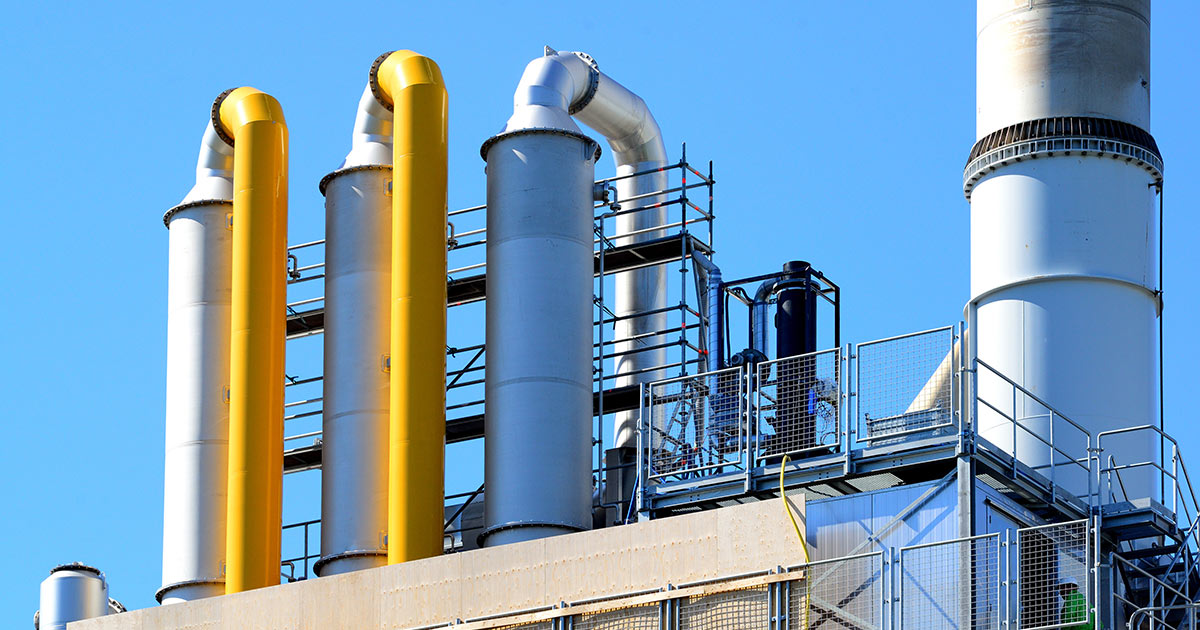
Sizing a Wet Scrubber: What a 50,000 CFM Rating Means
Summary
A wet scrubber's CFM rating sets its cross-sectional area, but it doesn't size the unit by itself. Engineers also need actual CFM at operating temperature, contaminant loading, required removal efficiency, outlet particle size, location, configuration, recirculation type, secondary containment, and expected future airflow, because those inputs set packing depth, mist eliminator type, pump size, and pressure drop.
A 50,000 CFM (cubic feet per minute) rating tells you how much exhaust a wet scrubber is built to move. But it doesn't tell you whether that scrubber will clean the air to your exact permit requirement. Two units with the same rating can differ by several feet of height and hundreds of gallons per minute of pump flow, because airflow is just one of eight inputs engineers need to know before sizing a chemical wet scrubber correctly.
The other seven determine most of what you're buying.
Here's how the request usually arrives. An engineer calls a manufacturer and asks for a 35,000 CFM scrubber. If that manufacturer only builds round towers, the answer roughly amounts to "this is what we got." Nobody asked about removal efficiency, gas temperature, or the outlet target. Nobody asked whether the plant plans to add equipment in the next few years, or how much more exhaust.
Those questions are essential to sizing the scrubber. And you’ll want to start with what the CFM number tells you.
Key Takeaways
- A CFM rating sets a wet scrubber's cross-section. Removal efficiency, outlet particle size, and contaminant loading set its height, pump size, and pressure drop.
- Size from CFM at operating temperature. Air measured at 70°F takes up about 25% more space at 200°F.
- Packing depth on scrubbers tends to run from 12" to 180". Deeper packing increases removal and pressure drop.
- If your outlet target is finer than mist eliminator blades can reach, add a mesh pad and increase height.
- Give your scrubber engineer the tool count you'll have in three years, not the one you have today.
What a CFM Rating Tells You
It sets the cross-section. Industry experts design packing for a gas velocity of 400 to 600 feet per minute, so a 50,000 CFM unit needs roughly 83 to 125 square feet of open packing face.
One catch before you use the number.
We recommend you identify inlet flow in ACFM, actual cubic feet per minute at the temperature the gas arrives. Hot exhaust expands. Air measured as 50,000 CFM at 70°F occupies about 62,000 CFM at 200°F. Size the packing face to the cold number and the gas moves through it roughly 25% faster than the design allows.
The Eight Inputs That Size a Chemical Scrubber
Viron's design checklist asks for:
- Inlet gas flow, in ACFM
- Inlet loading of each contaminant, in ppm or pounds per hour
- Gas temperature
- Required removal efficiency
- Location: indoors or outdoors
- Configuration: horizontal or vertical
- Recirculation: remote or self-contained
- Secondary containment: none, partial, or full
The first four decide whether the unit does its job. The last four decide where it fits, how much weight sits on the roof, and where the acid goes when a flange leaks.
8 Numbers That Size a Wet Scrubber
CFM is the first one, not the last.
Viron International · 50+ years building corrosion-resistant air pollution control systems
Removal Efficiency Sets the Height
Packing depth on vertical and horizontal packed bed scrubbers in ranges from 12" to 180". A typical starting point is 60", with 72" available for enhanced removal at a higher pressure drop.
Here’s one handy rule of thumb: if you need 98% or 99% removal on a specific chemical, plan on a bigger unit than the airflow alone suggests.
The extra packing keeps costing you after it ships. More depth adds static pressure, and more static pressure means more fan horsepower for as long as the system runs. (Our post on industrial centrifugal fans covers how that resistance gets sized.)
So we'd design to the efficiency your permit requires, with a sensible margin. If your permit calls for 95% and the spec says 99%, you're buying pressure drops you'll pay for every hour the fan runs.
Inlet loading works on the liquid side. Top-performing scrubbers run 2 to 15 GPM of recirculation per square foot of open packing, with 4 GPM as the standard design. On 100 square feet of packing, the ends of that range are a 200 GPM pump and a 1,500 GPM pump. Heavier contaminant loads push a design up the range, and the pump, piping, and sump grow with it.
Outlet Particle Size Decides the Mist Eliminator
The mist eliminator keeps scrubbing liquid, and whatever it captured, from leaving the stack. Standard horizontal crossflow blades capture 99% of 20-micron droplets. Its vertical counter-current blades capture 99% of 32-micron droplets. A composite mesh pad gets to 99% at 3 microns.
If your outlet target is finer than the blades can reach, you add a mesh pad stage, and the scrubber gets taller.
On Viron units, the body bumps out at the packing, mist eliminator, and mesh pad levels, so each component rests on the shell instead of a bonded internal shelf. We estimate the design removes 70% to 80% of the internal bonds in a scrubber. Internal bonds are where fiberglass fails first. Fewer bonds means there are fewer places to fail.
Configuration, Location, and Recirculation Change the Footprint
It may be the same 50,000 CFM, but it’s a different machine.
A vertical tower saturates its packing more easily, so it runs a smaller pump and motor and uses less electricity over its life. A horizontal unit has a lower profile, which suits rooftops and low ceilings, and technicians reach the spray headers without an extension ladder. The tradeoff is a bigger pump working at higher pressure.
Location brings its own list. An outdoor odor-control scrubber at a wastewater plant in a cold climate needs sump heaters, or a remote recirculation tank inside the building, which also takes the water weight off the roof. Outdoor controls go in NEMA 4X enclosures. Hold-down lugs handle wind and seismic loads.
Secondary containment is the item on the checklist most likely to get pushed to later.
Every flange on the recirculation piping carries acid or caustic, and every flange is a possible leak. A standard containment pan catches what drips to the base. Viron also builds a fiberglass shell that encloses all the plumbing, so a leak stays inside the unit and drains to containment, with access doors for routine pump service and a removable wall for bigger jobs.
Our design checklist puts containment next to packing depth as a decision to make early, and that's where it belongs.
Size for the Plant You'll Have in Three Years
We see this one often in semiconductor and high-tech facilities. A plant buys a scrubber for the five tools going in now. A year later, four more tools are on the plan, and all nine exhaust to a unit sized for five.
Nobody made a bad purchase. They simply answered the sizing question for the wrong year.
You should ask process engineering for the tool roadmap before the scrubber goes out for quote, and size the fan and ductwork against the same future load. Changing a scrubber after the duct, fan, and pad are in place means a capital project on a shutdown schedule.
Bring Viron the Numbers, Even Rough Ones
At Viron, we ask clients for the eight inputs above, plus the mist eliminator efficiency you need. If you don’t have all of them, send over what you have, even if the loading rates are estimates and the tool count is still a forecast. Our engineers will tell you which gaps change the size and which don't, and the scrubber, fan, and ductwork get designed against one set of numbers.
Viron has manufactured corrosive air handling systems for over 50 years across semiconductor fabs, municipal wastewater facilities, metal finishing operations, and industrial chemical applications. We'll tell you what we need to size and select the proper wet scrubbers for your system.
Frequently Asked Questions About Sizing Wet Scrubbers
What's the smallest and largest wet scrubber Viron builds?
Viron's standard horizontal and vertical scrubbers range from 500 to 100,000 CFM. Units below 500 CFM are available on request, and Viron also quotes custom designs for anything outside the standard sizes. Our blower-scrubber line, which combines the fan and scrubber in one package, covers smaller applications up to 15,000 CFM.
Can I size a scrubber from my exhaust fan's rated CFM?
Not reliably. A fan's rating applies at a specific static pressure, and the airflow it delivers depends on the resistance of the ducts, fittings, and scrubber it's pulling through. Start from the exhaust each tool, tank, or hood requires at operating temperature, then size the fan to the scrubber's pressure drop and the installed duct run.
Does the scrubbing chemistry change the equipment package?
Yes, even when the airflow stays the same. Acid and caustic scrubbing typically add a pH controller and a metering pump for chemical dosing. Caustic systems that dissolve solid flakes need a mixer, and conductivity control with automated blowdown keeps dissolved solids in check. Each adds piping and controls around the scrubber.